Building 5G TN/NTN Resilience with Simulation
October 12, 2026

October 12, 2026
In an increasingly unpredictable world, communication system resilience has become a growing priority. However, networks are not truly tested when conditions are ideal. Their resilience is revealed when conditions deteriorate.
From cyberattacks and GPS jamming to environmental effects and unexpected traffic surges, modern terrestrial (TN) and non-terrestrial networks (NTN) face an increasingly complex threat environment.
As organizations become more dependent on terrestrial, non-terrestrial, and hybrid communication networks, testing resilience before deployment is essential.
System-level simulation and digital twins provide a practical way to identify vulnerabilities, evaluate mitigation strategies, and improve the resilience of 5G TN/NTN systems before they support critical operations.
Reliable and secure communications have never been more important. As individuals, organizations, and societies become increasingly dependent on digital services and connected devices, there is growing demand for communication systems that can continue operating under degraded conditions.
Satellite connectivity has added a new dimension to traditional terrestrial networks, making it possible to stay connected across oceans, remote regions, and in the air. Satellite networks are also becoming increasingly important for secure government and business communications – such as IRIS2 in Europe.
IRIS2 is a satellite network currently being designed by the European Union, aiming to strengthen Europe’s digital sovereignty and ensure that governments, emergency services, and citizens can stay connected in remote areas and during crises.
There is an increasing need to know how terrestrial and satellite networks perform in both normal operating conditions and when disruptions occur. Network resilience should be considered as a priority from the beginning of network design.
Modern communication systems face a growing range of threats, including cyberattacks, denial-of-service, electronic warfare such as jamming, satellite communication interference, and GPS jamming. These attacks can disrupt the flow of accurate information and degrade positioning, navigation, and timing services.
When a communication link is disrupted, the impact is rarely limited to a single connection. Disruptions can propagate throughout the communications chain, affecting satellite networks, connected platforms such as aircraft or vehicles, and the ground infrastructure. The effects can be significant, particularly when disruptions target systems supporting critical operations.
Understanding vulnerabilities before deployment is essential, but testing real-world disruption scenarios on operational networks is often impractical, expensive, or too risky.
This is where system-level simulation becomes valuable. By modelling satellite, terrestrial, and hybrid 5G TN/NTN systems across versatile operational conditions, organizations can evaluate network performance, identify weaknesses, and explore mitigation strategies without affecting live networks.
Unlike the analysis of isolated communication links, system-level simulation allows organizations to understand the complete communication ecosystem and system-wide interactions. This includes seeing how disruptions propagate across the system, from terrestrial infrastructure and user terminals to satellite networks and service applications.
Organizations evaluating 5G TN/NTN systems often face these kinds of questions:
System-level simulation and digital twins help answer these questions before communication systems are deployed.
Network architecture forms the foundation of system performance, security, and resilience. By incorporating simulation and digital twins early in the design process, resilience can become a core design principle.
System-level digital twins for terrestrial and satellite networks help identify architectural vulnerabilities and communication bottlenecks before deployment, when design changes are still relatively inexpensive to make. This allows engineers to evaluate how different design choices affect performance under both normal operating conditions and disruption scenarios.
By simulating the complete communications chain, organizations can perform end-to-end performance analysis across multiple system layers, including:
Simulation enables objective comparison of alternative network architectures, helping organizations understand performance trade-offs and select the solutions that best support their operational requirements.
A network may perform well in everyday operations, but resilience is often revealed when conditions become less predictable. Network performance testing through a system-level digital twin helps organizations understand how networks behave across different environments, operating conditions, and disruptions.
How does network performance change when signals are obstructed by terrain, buildings, or trees? What happens when user demand suddenly surges beyond expected levels? How does the system respond when terrestrial networks become unavailable due to a natural disaster and satellite networks must carry a significantly larger share of communications traffic?
By evaluating networks in adverse and less-than-ideal scenarios, organizations gain insights into system behavior that would otherwise remain hidden.
Simulation enables the exploration of both “what-if” and worst-case conditions, helping engineers understand network resilience, performance limits, and potential failure points before they occur in live environments.
In addition to validating purely terrestrial or non-terrestrial networks, Magister’s simulators can also be used to explore hybrid TN/NTN scenarios, which play a key role in network resilience.
Hybrid TN/NTN architectures combine terrestrial and non-terrestrial connectivity to improve service continuity and reliability. For example, it’s possible to design and evaluate fault-tolerant network architectures – utilizing simulation before deployment to analyze how a network performs when parts of the infrastructure become unavailable.
In hybrid TN/NTN scenarios, terrestrial and non-terrestrial networks complement one another. When an unexpected situation arises, all available networks can be seamlessly leveraged, with traffic switched between them as needed based on network availability. For example, if terrestrial connectivity becomes unavailable, connectivity can be maintained through non-terrestrial networks, and vice versa. The networks can fill each other’s coverage gaps, improving communication continuity even during crises and across remote areas.
Simulation can be used to study how these hybrid TN/NTN network operations work in practice, including traffic handovers, service continuity, coverage, and potential interference scenarios.
Communication systems can face a wide range of disruptions, from environmental conditions to intentional electronic warfare activities such as jamming. To assess resilience against these threats, Magister’s simulation platform includes configurable electronic warfare effects, allowing users to model jammer power, directionality, operating frequency, and timing patterns.
This makes it possible to evaluate network performance under different disruption scenarios and identify vulnerabilities before deployment.
Our digital twin environment enables organizations to test resilience strategies without placing operational systems at risk. These may include:
In addition to intentional attacks and environmental effects, network performance and service availability can also be affected by interference from satellite or terrestrial networks operating on overlapping frequencies.
By simulating both intentional and unintentional disruptions, organizations can better understand vulnerabilities, evaluate mitigation strategies, and improve terrestrial and satellite network resilience before real-world challenges occur.
Operators, analysts, and decision-makers must be prepared to respond effectively when disruptions occur. A digital twin environment helps them explore diverse scenarios, including degraded operations, equipment failures, and communication disruptions.
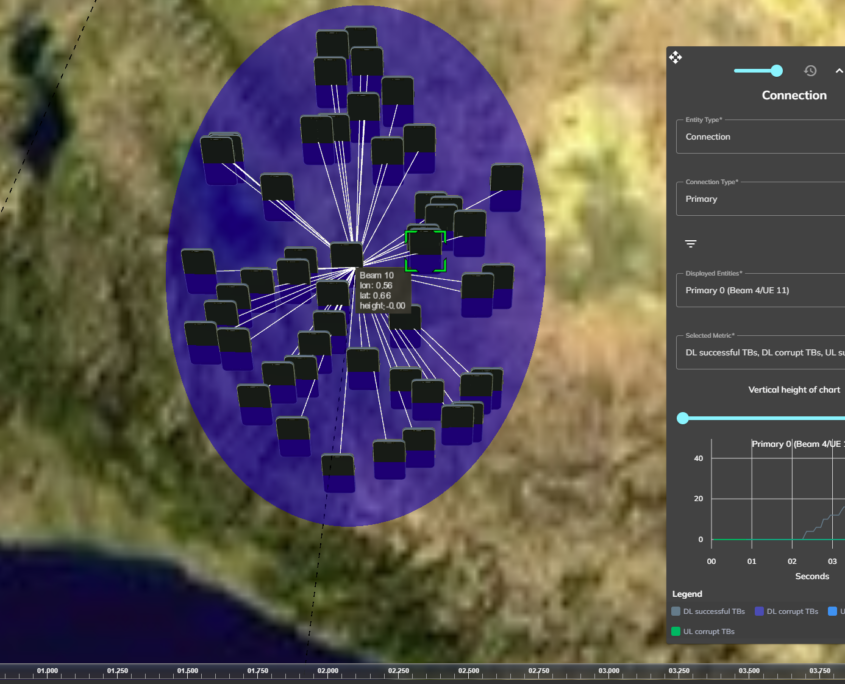
High-quality 3D animations help teams understand complex system behavior and communicate operational concepts more effectively to colleagues and customers.
Simulation provides a safe environment for developing operational intuition without interfering with live systems. Teams can learn to recognize early warning signs of potential issues, understand how disruptions propagate through a network, and practice response procedures before encountering similar situations in real operations.
Scenario-based analysis also helps organizations understand the operational significance of different threats. Disruptions have different kinds of impact, and resilience measures should be aligned with the risks that matter most.
By evaluating how various threat scenarios affect mission performance, organizations can determine whether a particular vulnerability is likely to cause a minor degradation in service or a critical operational failure. These insights can then guide network design improvements, resilience strategies, and resource prioritization.
System-level simulation enables organizations to understand how communication systems behave before they are deployed.
Whether evaluating network architectures, testing service continuity, analyzing disruption scenarios, or preparing operators for degraded conditions, simulation provides valuable insights that would otherwise be difficult to obtain before implementation.
As initiatives such as IRIS2 advance the future of secure satellite communications, simulation continues to play an increasingly important role in evaluating resilience, reducing deployment risk, and supporting more informed decision-making.
Build More Resilient 5G TN/NTN Systems with Simulation

Accelerating the future of wireless system development today with system-level digital twins and detailed simulations.



Sepänkatu 14 C 16 FIN-40720 Jyväskylä, Finland
Business ID: 1998796-8
VAT number: FI19987968
info(at)magister.fi