Supporting the deployment of highly dynamic satellite constellations through ESA collaboration
April 1, 2025

April 1, 2025

In the NTN-CPD project, we extended the ALIX simulator to make it possible to evaluate 5G control plane procedures with flexible NGSO constellations.
This helps users detect issues for standardization and industrial purposes.
Magister is again collaborating with the European Space Agency on new simulation development projects. The NTN-CPD project started in April 2024, ending in March 2026.
The goal of NTN-CPD was to define the control plane of the 5G New Radio (NR) standard for non-terrestrial networks (NTN) and demonstrate its performance in a software demonstrator.
Through these developments, we promote the deployment of highly dynamic satellite constellations. With the enhanced ALIX simulator, these systems and protocols can be assessed in high detail – from the perspectives of both the end user and the network.
The follow-up project CCN1 started in March 2026 and is scheduled to end in September 2026. CCN1 is a natural continuation of NTN-CPD, complementing the simulator features, and extending the NTN control plane functionality studies.
We’ve extended the existing ALIX simulator with the goal to enable the evaluation of 5G control plane procedures with flexible Non-Geostationary Satellite Orbit (NGSO) constellations.
This way, users can discover possible issues and optimization targets for standardization and industrial purposes. NGSO includes satellites in Low Earth and Medium Earth Orbit (LEO, MEO).
ALIX can model relevant control plane features that may impact 5G NTN performance in high-speed satellite scenarios. These include, for example, cell access, UE measurements, and mobility management.
The dynamically steered earth-fixed beams and Inter-Satellite Links (ISL) bring additional challenges to defining and implementing these features. Here, the simulator will be an effective tool.
The research was complemented with visualization and demonstration of the simulations through Magister SimLab.
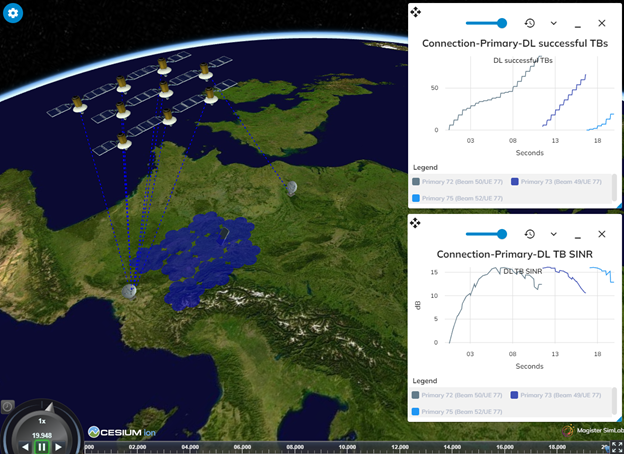
Small moving LEO Handover Test Scenario in Magister SimLab Visualization Player
ALIX aims to enable the evaluation of control planes of different NGSO constellations. This supports 3GPP-specified NTN system architectures, and both transparent and regenerative satellite systems.
The simulator focuses on satellite constellations within one type of orbit. This also includes multi-orbit constellations – however, with no cross-orbit communication. The architecture supports simple Inter-Satellite Links (ISLs) and functional splitting of the gNB in regenerative satellite systems.
The system architecture reflects the project’s objectives. This means that greater focus is placed on the control plane rather than the user plane. The architecture focuses on the radio access network, while the core network and backhaul connections are largely simplified.
ALIX is designed to accurately simulate subsets of the whole constellation. Subsets of satellites can be selected dynamically, based on the area of interest.
The new features of ALIX were introduced in three different software versions. Version 1 included a selection of NR-NTN Release 17 features and functionality, including RRC signaling and messages, feeder link, conditional handover, and UE measurements.
Version 2 focused on 3GPP Release 18 and Release 19 control plane features, especially VSAT UE operability and regenerative satellite payload. This includes, for example, RACH-less handover, satellite switch with re-sync, and Inter-Satellite Links.
Version 3 didn’t contain implementation of major new features. Instead, it focused on improvements and bug fixes of the code base and parameter optimization of the simulators. This version was also used in the analysis of the implemented features in relevant scenarios.
> See all features here
The project had the following objectives:

Accelerating the future of wireless system development today with system-level digital twins and detailed simulations.



Sepänkatu 14 C 16 FIN-40720 Jyväskylä, Finland
Business ID: 1998796-8
VAT number: FI19987968
info(at)magister.fi