Design Industrial IoT Networks You Can Trust –
Practical Checklist & Simulation Insights
March 30, 2026

March 30, 2026

In industrial environments where efficiency, reliability, and safety are paramount, Industrial IoT plays a key role. By connecting facilities through networks, it enhances predictive maintenance, safety, and situational awareness.
Designing a reliable Industrial IoT system requires careful consideration of network technologies, physical environments, and security. Early decisions around system architecture often determine how well the system will support operations over time.
With over 20 years of expertise across terrestrial and non-terrestrial wireless technologies such as 4G/LTE, 5G TN/NTN, Wi-Fi, and NB-IoT, Magister Solutions helps organizations evaluate network performance and reduce deployment risks from the start. Our system-level simulation tools provide a realistic view of network behavior in IoT scenarios.
Industrial IoT (IIoT) refers to ecosystems of connected sensors, machines, and software used in industrial settings such as manufacturing to collect data, monitor operations, and support decision-making. Sensors embedded in machinery track parameters like temperature and energy consumption, transmitting this data to processing systems for analysis.
These insights help optimize production processes, improve equipment health, and reduce downtime. Artificial intelligence is often integrated into IIoT systems to detect patterns, identify anomalies, and predict failures before they occur.
Choosing the right network is one of the most critical design decisions in any IoT deployment. Challenges often arise not from individual technologies, but from mismatches between operational requirements, physical conditions, and network design choices.
Here are examples of common networks utilized in industrial IoT, with their typical use cases and environments, key strengths, as well as key limitations.
Technology |
Typical IIoT Use Cases |
Key Strengths |
Key Limitations |
Best Fit Environments |
| Wi-Fi | Real-time monitoring, tracking, sensors (cameras, audio, etc.) | Fast data transfer, sufficient bandwidth for real-time monitoring and time-sensitive uses | Limited range, prone to interferences, insufficient security for handling sensitive business data | Small to medium industrial facilities with high‑data and low‑latency connectivity needs |
| 4G/LTE | Mobile assets, wide-area monitoring, outdoor industrial connectivity | Good coverage, strong security, mobility support | Small latency not suitable for applications where instantaneous decisions are needed | Large and distributed industrial environments |
| 5G NR | High-performance industrial applications, automation, data-intensive workloads | High data rates, low latency, diverse use cases, cutting-edge technology | Availability varies, uneven coverage, costly implementation | Industrial sites with high performance requirements and real-time applications |
| Private 5G | Mission-critical IIoT, automation, real-time control, advanced analytics | Deterministic performance, low latency, strong security, full network control | Higher deployment cost, complex deployment | Critical industrial environments with strict performance and security requirements |
| LPWAN | Condition monitoring, metering, simple sensors | Long range, low energy consumption, cost-efficiency | Limited data transmission rates, prone to latency and delays | Facilities with monitoring needs, large distances, low data volumes & high power efficiency requirements |
| NB-IoT | Smart metering, machine monitoring, inventory management | Long range, high building penetration, low energy consumption | Limited data throughput, poor mobility support, latency too high for real-time applications | Facilities with monitoring needs, large distances & low data volumes |
| Bluetooth | Building sensors, asset tracking, wearables | Ultra-low power consumption, RF performance, cost-competitive | Short range, limited scalability | Localized indoor environments, close-range connectivity |
| Wired networks | Fixed machines, legacy systems, deterministic control | High reliability, low latency, predictable performance | High installation cost, inflexible, difficult to scale or modify | Static industrial setups with minimal layout changes |
| Satellite | Connecting remote assets, offshore facilities, areas without terrestrial networks | Global coverage, independent of local infrastructure | Higher latency, cost, and bandwidth constraints | Remote or hard‑to‑reach locations |
Wi-Fi is widely used due to its low cost and ease of deployment, but may struggle with reliability and coverage in large, mission-critical sites. Cellular technologies, like 4G and 5G, provide broader coverage, stronger security, and low latency. Private 5G offers enhanced control and security for the organization.
Low-Power Wide-Area Networks (LPWAN) are designed specifically for IoT, enabling long-range, low-energy communication. Narrowband IoT (NB-IoT) is a commonly used LPWAN technology, focusing on indoor coverage and offering support for large numbers of devices.
Bluetooth is also emerging as an option for IIoT, offering low power consumption and competitive pricing. Wired networks are also utilized, being generally considered more reliable than wireless connections. However, they lack flexibility and are more expensive to install than wireless options.
Advances in 3GPP standardization have also made Non-Terrestrial Networks, such as satellite, viable options for IIoT. These technologies are especially valuable in remote or hard-to-reach locations where terrestrial infrastructure is unavailable. For example, Sateliot operates the world’s first 5G NB-IoT satellite constellation and is collaborating with Magister Solutions on constellation development.
> Read more: Sateliot chose Magister Solutions as a collaborator for developing their Low Earth Orbit satellite constellation
With over two decades of experience in wireless network simulation, design, and research, Magister Solutions helps organizations across industries build reliable networks, reduce deployment risks, and speed up development through accurate virtual prototyping.
Our expertise spans a wide spectrum of wireless technologies, such as 5G NR, 4G/LTE, NB-IoT, Wi-Fi, satellite, and TN/NTN. Because we are a fully independent company, our system-level evaluations are objective by design – giving transparent comparisons of performance, coverage, and security. Using advanced simulation tools developed and validated through European Space Agency projects, we combine theoretical analysis with realistic simulated scenarios to support informed decision-making.
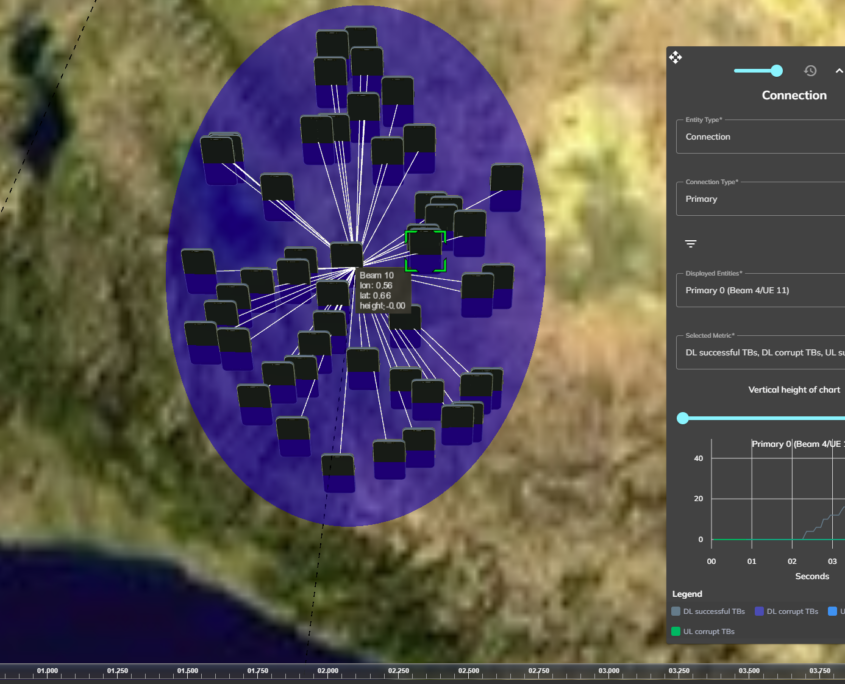
Our C-DReAM and ALIX simulators help optimize wireless systems across diverse environments. Both are integrated into our Magister SimLab platform, enabling efficient design, monitoring, visualization, and analysis of complex systems. 3D visualizations bring these scenarios to life, making them easy to understand and share across teams and stakeholders – and highly effective for engaging sales demonstrations.
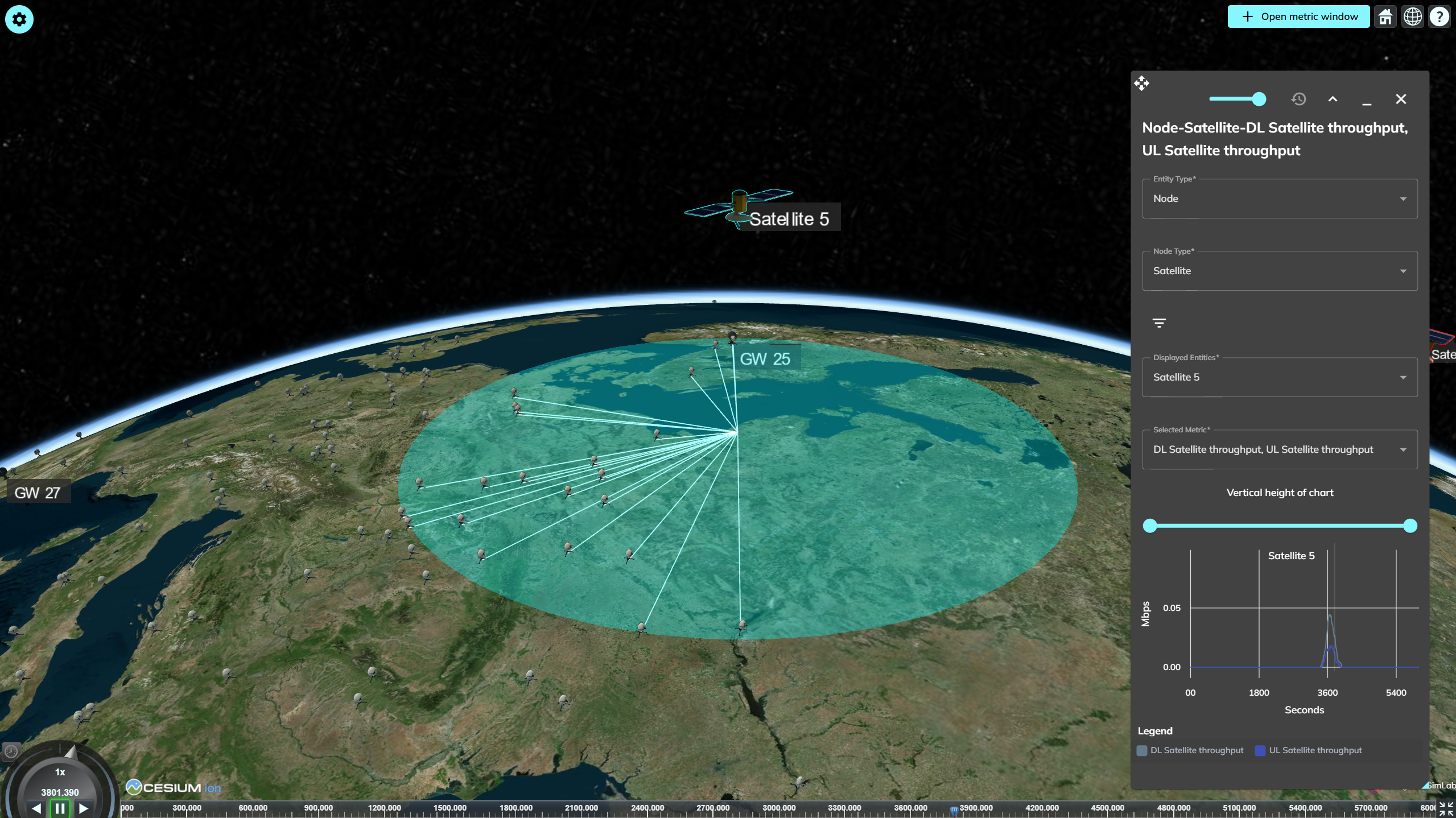
C-DReAM simulating an NTN NB-IoT scenario
C-DReAM is a system-level simulator for satellite communication networks, supporting technologies such as 5G TN/NTN, NTN NB-IoT, and DVB-S2X. It is utilized for designing satellite constellations, from small to mega-sized LEO, MEO, and GEO systems. C-DReAM lets you explore system performance across different satellite counts, ground-station configurations, traffic demands, and interference conditions.
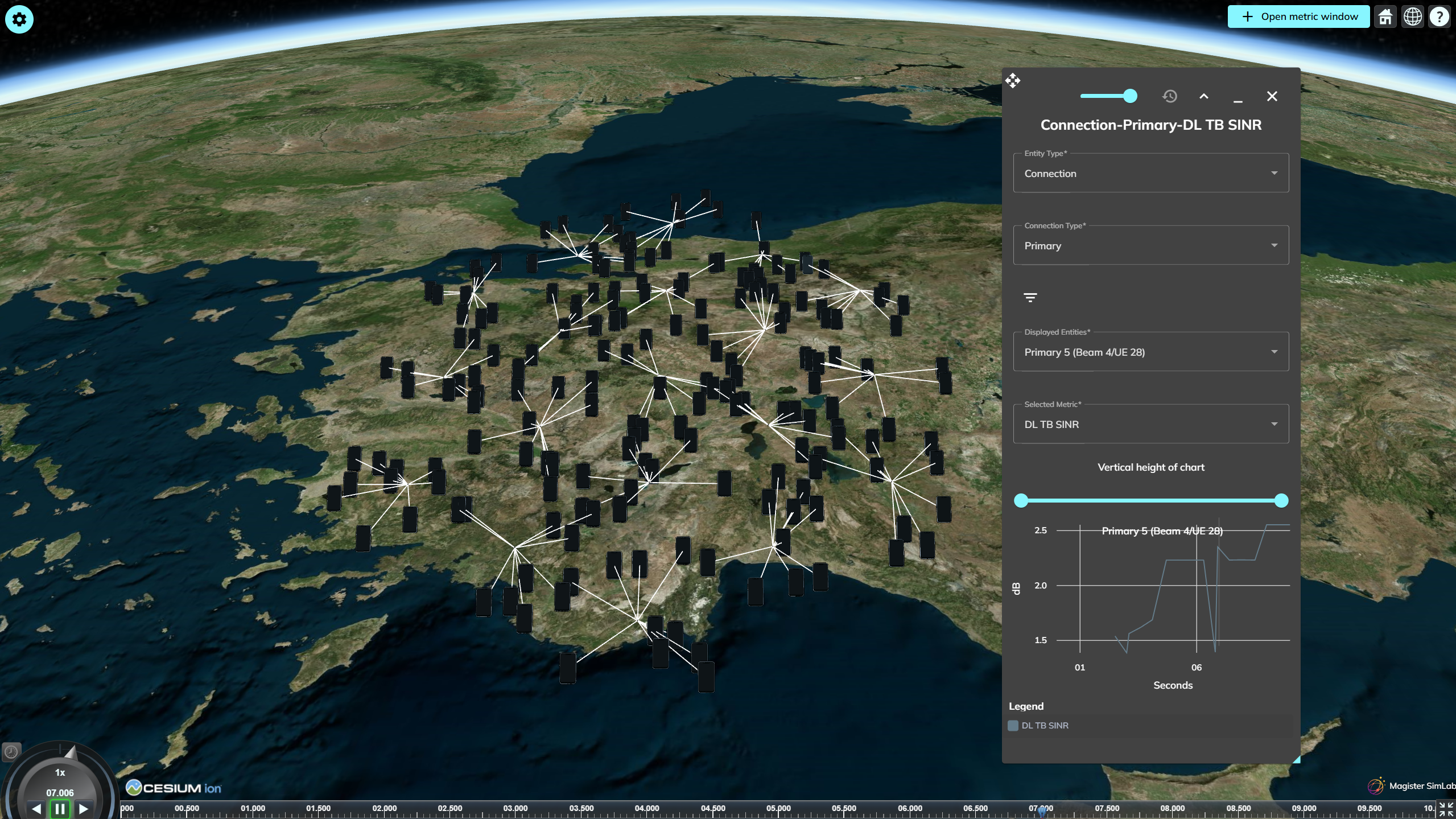
ALIX simulating an NTN NB-IoT scenario
ALIX is a system-level simulator for detailed protocol-level simulations of 5G terrestrial and non-terrestrial networks. It’s used for 3GPP standardization, network performance evaluation, and technology development. At Magister, ALIX has supported 5G-Advanced and 6G NTN research by analyzing future technology potential and system behavior at protocol level.
✓ Identify the best technology fit. Compare wireless technologies and devices without vendor bias to determine the most reliable, cost-efficient, and future-ready option for your industrial environment.
✓ Understand network behavior under real-world stress. Assess performance under varying traffic loads, interference levels, jamming attempts, and environmental constraints – before you invest in physical deployments.
✓ See how your environment impacts connectivity. Model terrain-aware propagation to understand the effects of buildings, obstacles, machinery, and facility layout on system coverage and reliability.
✓ Spot vulnerabilities early. Analyze bottlenecks and weaknesses in your system architecture during the design phase to reduce risk, improve resilience, and avoid costly redesigns later.
✓ Accelerate innovation with simulation-driven prototyping. Explore emerging technologies, validate new ideas quickly, and build proof-of-concepts without expensive field tests or hardware iterations.
✓ Guarantee the right service quality for end users. Evaluate Quality-of-Service, prioritization, and routing strategies to ensure mission-critical devices get the performance and reliability they need.
✓ Understand how mobility changes impact connectivity. Analyze how moving devices – like vehicles, drones, and ships – stay connected as they transition between beams, cells, or satellites. Evaluate handover performance, coverage gaps, and latency to ensure continuous connectivity.
Despite its many benefits, IIoT also introduces new risks. When tens, hundreds, or thousands of devices continuously exchange sensitive operational data, a single weak point can have serious consequences.
From our experience, cascading failures often originate from early architectural decisions – for example, underestimated traffic volumes or insufficient interference planning.
In industrial environments with strict safety requirements and high operational stakes, IIoT connectivity must be an enabler, not a source of uncertainty. Below is a list of key aspects to evaluate when planning an IIoT system.
2. Environment & Physical Layout
3. Devices & Connectivity
4. Safety, Security & Compliance
5. Data Architecture & Processing
6. Business & Sustainability Factors
Whether you’re designing an industrial IoT system or comparing network solutions, you’ve come to the right place.
We combine deep simulation expertise with practical industry insight to guide you through critical decisions and create a resilient, future-ready IoT system tailored to your environment.

Accelerating the future of wireless system development today with system-level digital twins and detailed simulations.



Sepänkatu 14 C 16 FIN-40720 Jyväskylä, Finland
Business ID: 1998796-8
VAT number: FI19987968
info(at)magister.fi