Keep up with 3GPP standardization
Ensure compatibility with the latest 3GPP developments related to 5G, 5G-Advanced, and 6G TN & NTN.

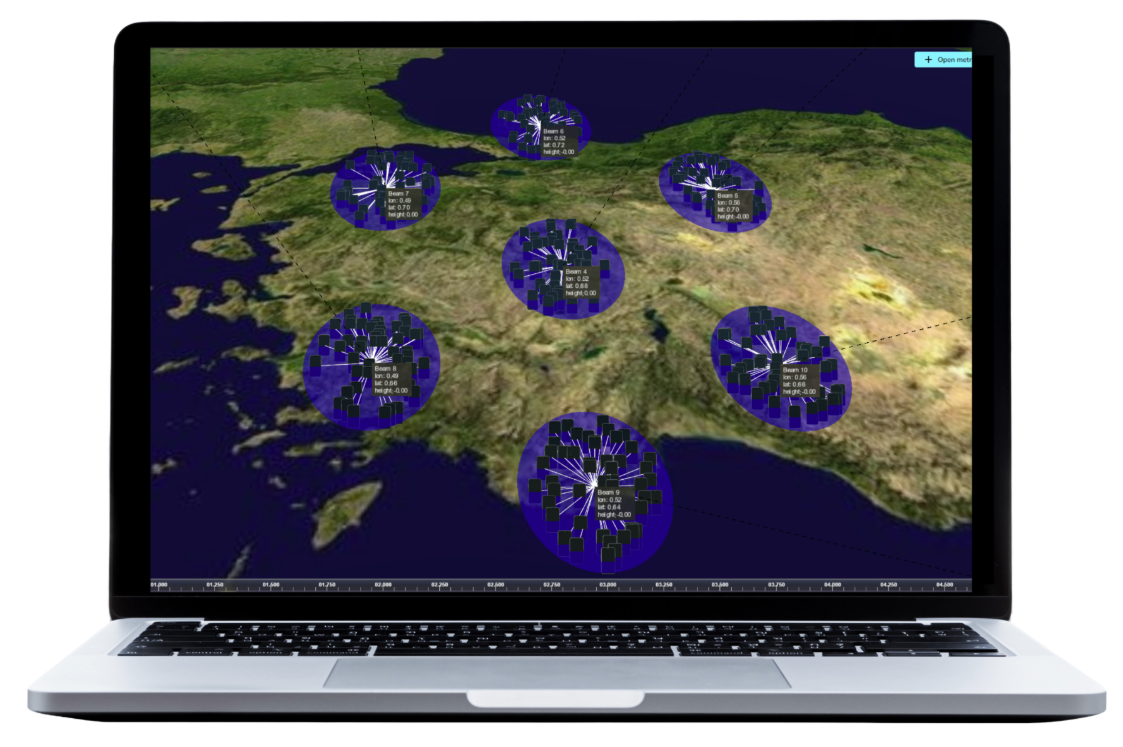

ALIX is a 5G TN/NTN system-level simulator that is used for detailed protocol level simulations for 5G Terrestrial and Non-Terrestrial Networks.
Operating on a packet level resolution, ALIX makes it possible to evaluate communication technology performance, keep up with 3GPP 5G TN/NTN standardization efforts, and explore future technologies such as 5G-Advanced and 6G NTN.
Ensure compatibility with the latest 3GPP developments related to 5G, 5G-Advanced, and 6G TN & NTN.
For example: performance differences between DVB-S2X and 5G NR.
Optimize, refine, and develop your future network systems.
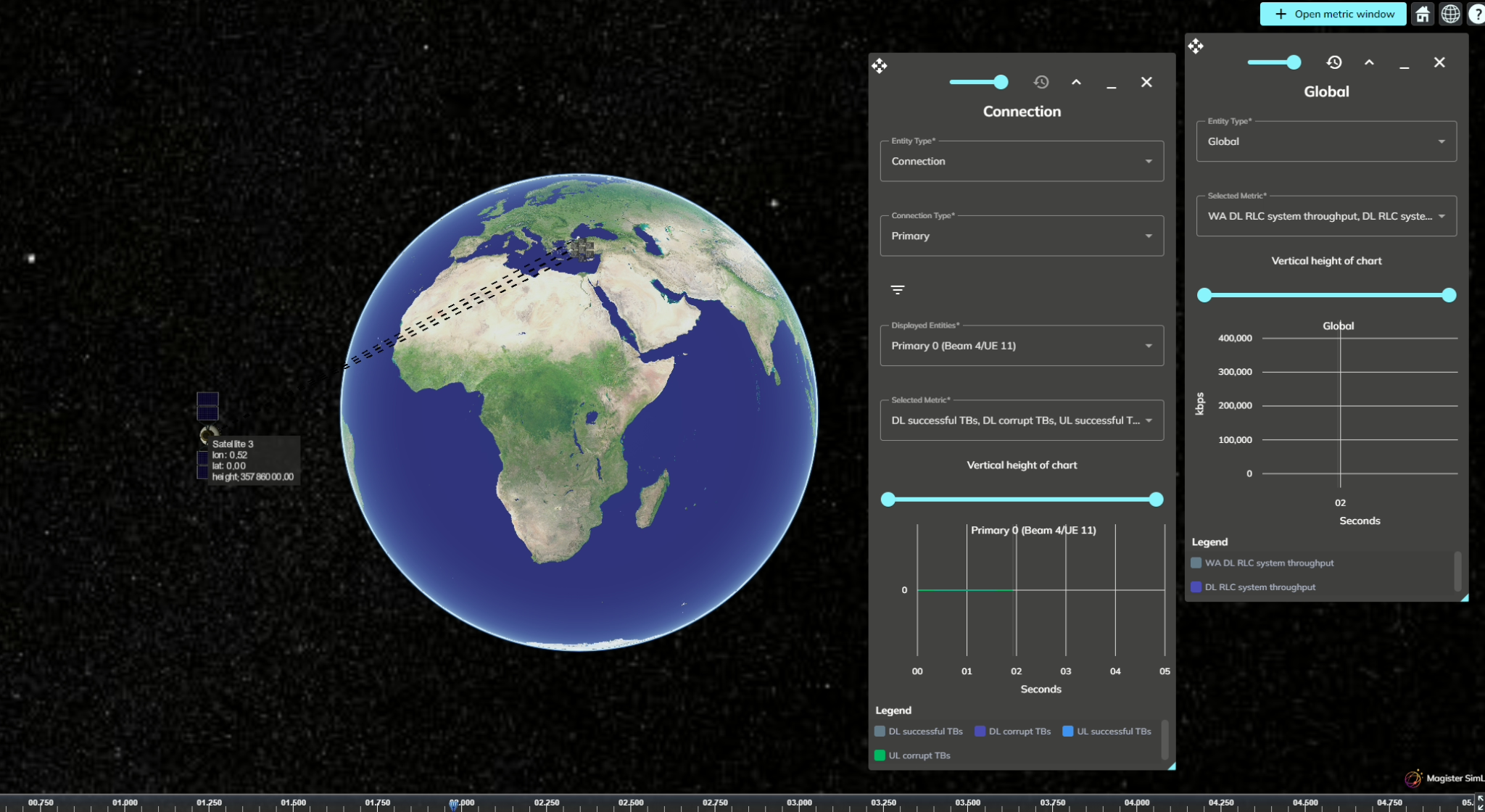
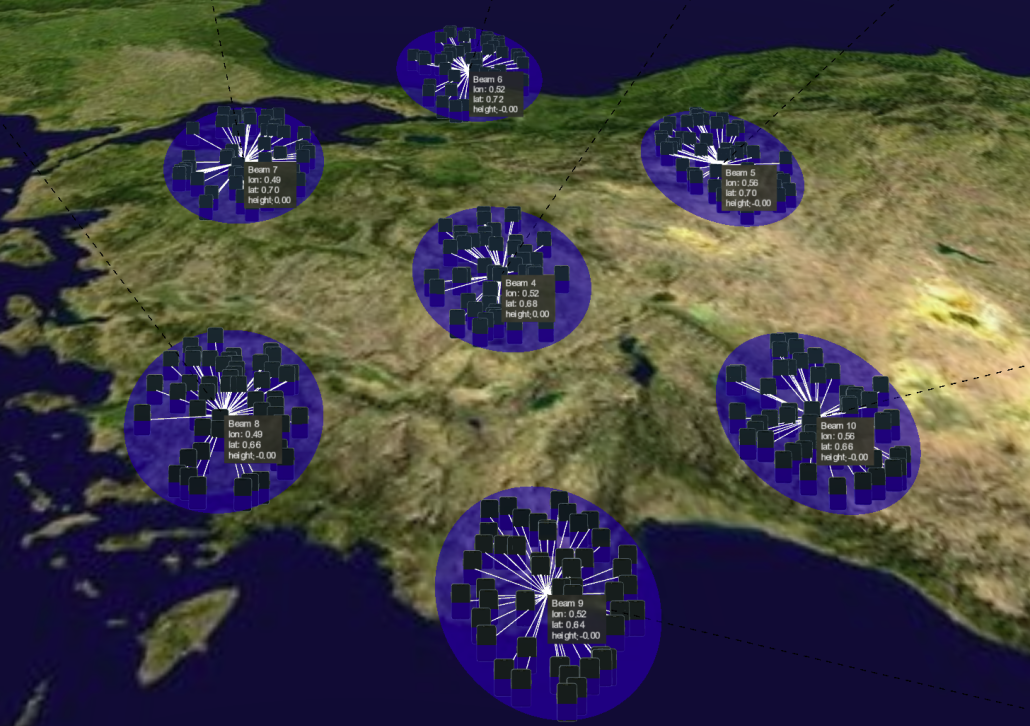

In the MARINA project, Magister developed a fair method for comparing DVB-S2X and 5G NR technologies.
We collaborated with Thales Alenia France, who focused on Link Level simulations while we worked on System Level Simulations.
By combining the efforts of our ALIX and SNS3 simulators, we were able to develop a transparent method for comparing DVB-S2X and 5G NR.
These findings are crucial information for standardization processes.
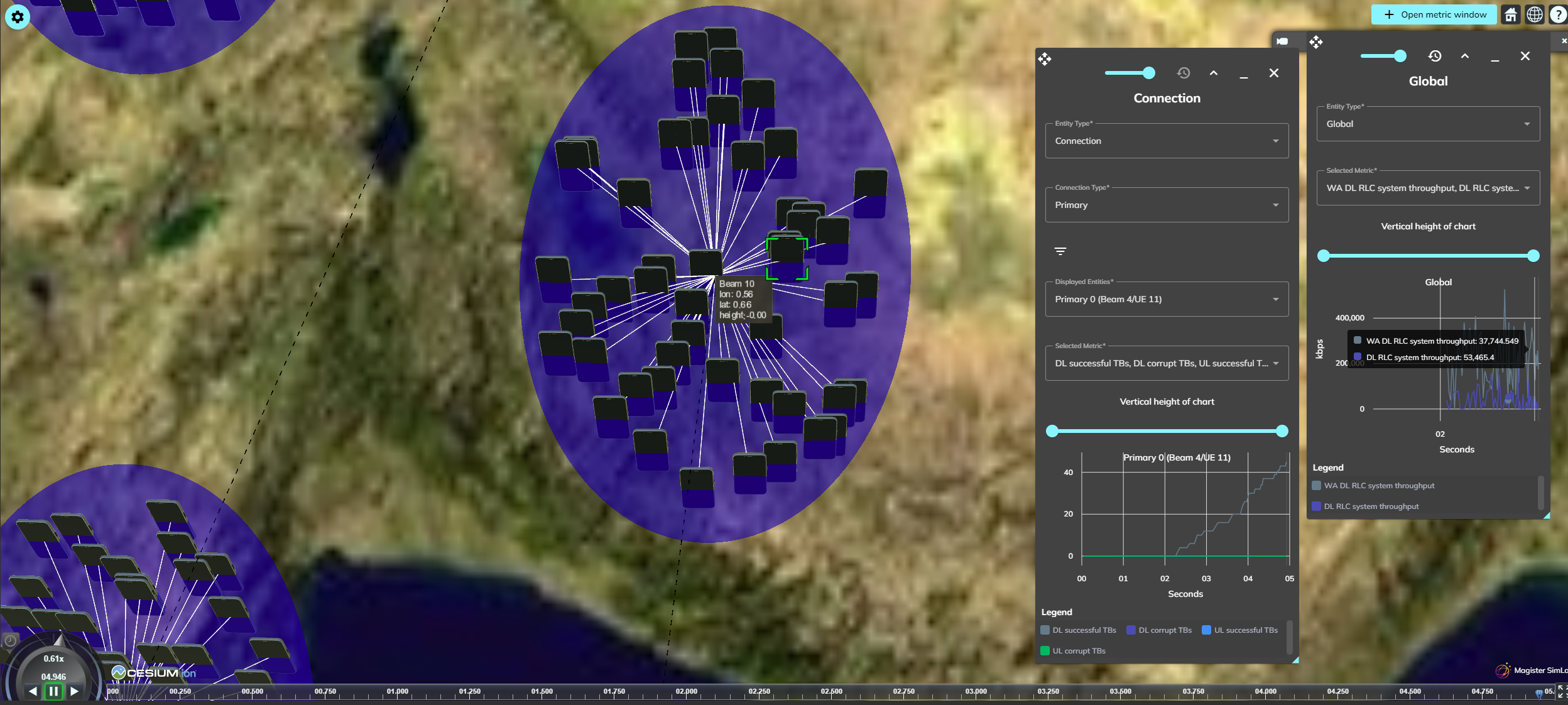
Magister has developed the ALIX 5G simulator through projects with the European Space Agency and the European Union, and our internal development work. These projects include, for example, ALIX, SAIRCC, HELENA, and DYNASAT (EU Horizon).
3GPP 5G NR NTN Technologies in a Geostationary Satellite Scenario / Best Paper Award ASMS/SPSC 2025
3GPP 5G NR NTN Technologies in a Geostationary Satellite Scenario / Lauri Sormunen, Tuomas Huikko, Verneri Rönty, Erno Seppänen, Sami Rantanen, Frans Laakso, Vesa Hytönen, Mikko Majamaa, Jani Puttonen
Best Paper Award / Industrial Relevance, the 12th Advanced Satellite Multimedia Systems Conference and the 18th Signal Processing for Space Communications Workshop 2025
Comparison between existing, well-established satellite technologies, like the Digital Video Broadcasting (DVB) satellite specifications, and the emerging Third Generation Partnership Project (3GPP) specified 5th Generation New Radio (5G NR) Non-Terrestrial Networks (NTN) is an actively discussed topic in the satellite industry standardization groups.
This article presents a thorough performance comparison between DVB Second Generation Satellite Extensions (DVBS2X) and Return Channel via Satellite 2nd Generation (DVBRCS2), and NR NTN in a Geostationary Orbit (GEO) satellite scenario, using system-level simulators (SLS) for evaluation, namely Satellite Network Simulator 3 (SNS3) and ALIX 5G (TN-)NTN SLS, built on the same Network Simulator 3 (ns-3) platform.
With the satellite system geometry, beam layout, and link budget aligned to use the 3GPP NTN example parameterization for a fair comparison between DVB and NR NTN, the results show that DVB-S2X consistently achieves higher spectral efficiency than the NR Physical Downlink Shared Channel (PDSCH) on the forward user link. In contrast, on the return link, the NR Physical Uplink Shared Channel (PUSCH) demonstrates better spectral efficiency at the system level. The SLS results incorporate link-level performance, obtained through link-level simulations (LLS) for different modulation and coding schemes (MCS) and waveforms supported by each technology.

Co-existence of Terrestrial and Non-Terrestrial Networks on Adjacent Frequency Bands
Co-existence of Terrestrial and Non-Terrestrial Networks on Adjacent Frequency Bands/ Lauri Sormunen, Henrik Martikainen, Jani Puttonen, Dorin Panaitopol, The 11th Advanced Satellite Multimedia Conference and the 17th Signal Processing for Space Communications Workshop (ASMS/SPSC), 6–8 September 2022.
This paper presents the latest achievements concerning 3GPP Release-17 adjacent band coexistence simulation work on 5G new radio non-terrestrial networks (NTNs) for satellite communications.
The main conclusions can be summarized as follows: (1) NTN UE can reuse the current requirements of the TN UE, (2) the satellite connectivity does not require a dedicated satellite waveform, and (3) TN can co-exist with NTN on adjacent channels with relaxed ACIR requirements for the tested simulation scenario.

Multi-Connectivity in 5G and Beyond Non-Terrestrial Networks
Multi-Connectivity in 5G and Beyond Non-Terrestrial Networks / Mikko Majamaa, Henrik Martikainen, Lauri Sormunen, and Jani Puttonen, Journal of Communications Software and Systems, 2022.
The Fifth Generation (5G) communications systems aim to serve such service classes as Ultra-Reliable Low Latency Communications (URLLC), enhanced Mobile Broadband (eMBB), and massive Machine-Type Communications (mMTC).
To meet the growing requirements posed to mobile networks, satellites can be used to complement the Terrestrial Networks (TNs). To increase the efficiency of the satellite communications involved, bandwidth-efficient techniques should be used. Multi-Connectivity (MC) is one such technique. In MC, a User Equipment (UE), for example, a smartphone, can be connected to multiple Next Generation Node Bs (gNBs) simultaneously.
In this paper, an adaptive MC activation scheme for throughput enhancement in 5G and beyond Non-Terrestrial Networks (NTNs) is presented. The algorithm is evaluated by system simulations using different traffic split algorithms, namely, even split, data request per connection and per gNB algorithms. In the considered simulation scenario, the maximum throughput enhancement of 9.1%, compared to when MC is turned off, is experienced when using the adaptive Secondary Node (SN) addition algorithm with the combination of the data request algorithms.

A System Simulator for 5G Non-Terrestrial Network Evaluations
A System Simulator for 5G Non-Terrestrial Network Evaluations / Jani Puttonen, Lauri Sormunen, Henrik Martikainen, Sami Rantanen, Janne Kurjenniemi, IEEE International Symposium on a World of Wireless, Mobile and Multimedia Networks (WoWMoM), Non-Terrestrial Networks in 6G Wireless workshop, June 7-11, 2021.
The 3rd Generation Partnership Project (3GPP) is working on the specifications related to the 5G satellite component, i.e., 5G Non-Terrestrial Networks (NTN). 5G NTN specifications can be used to build different spaceborne or airborne 5G systems.
This article presents a 5G NTN extension to an open-source Network Simulator 3 (ns-3) and its 5G extension (5G LENA). The objective is to use the resulting System Level Simulator (SLS) in 3GPP standardization to evaluate different system concepts and parameterizations.

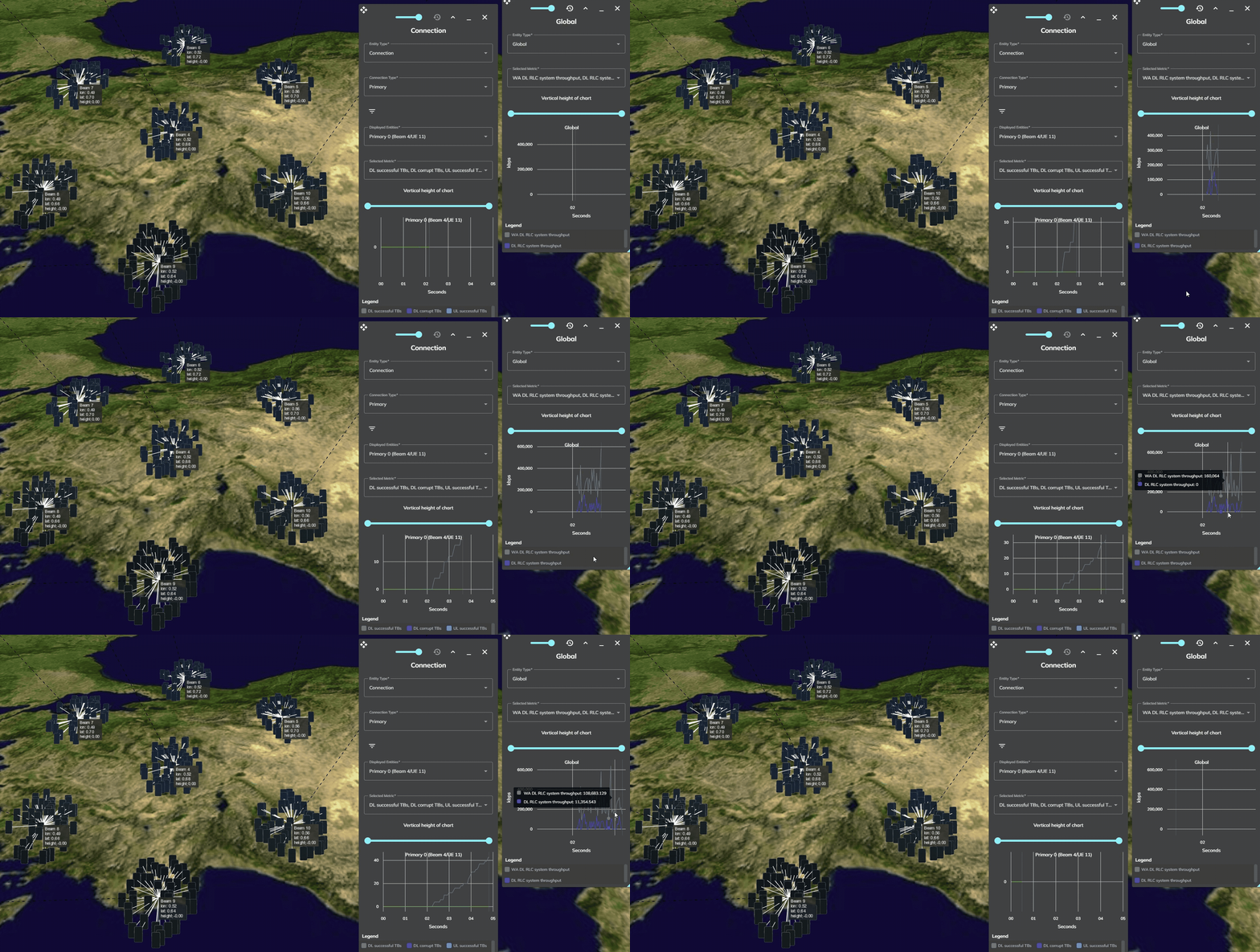
For example:
Also supports:
Rather than control plane
Or custom altitude, frequency, and terminal configuration.
Book an online meeting about ALIX with our simulation experts. We’ll walk you through the simulator’s capabilities and discuss your potential usage scenarios.

Accelerating the future of wireless system development today with system-level digital twins and detailed simulations.



Sepänkatu 14 C 16 FIN-40720 Jyväskylä, Finland
Business ID: 1998796-8
VAT number: FI19987968
info(at)magister.fi