Intelligent Aviation: How System-Level Digital Twins Optimize Airborne Operations
December 12, 2025

December 12, 2025

The safety and efficiency of aviation depend not only on the performance of individual aircraft and their onboard sensors and systems, but also on the communication and coordination between airplanes, UAVs, airports, air traffic control, and satellites.
Managing these operations requires predictive, system-level insights – and system-level digital twins deliver exactly that. By creating virtual replicas of aircraft, airborne networks, sensors, and disruptions, it’s possible to simulate flight behavior, model unit interactions, and evaluate operational scenarios, all without putting equipment or crews at risk.
These simulations provide actionable insights for optimizing flight paths, improving situational awareness, and reducing operational risks. In the sections that follow, we introduce six critical areas where digital twins are reshaping the design and management of aviation systems.
Understanding the movement of aircraft – their climb rates, acceleration, turning, and descent patterns – is fundamental to planning safe and efficient aviation operations.
This applies to commercial and military airplanes, unmanned aerial vehicles (UAV), and high-altitude platforms (HAPS), each of which exhibit distinct flight characteristics that must be carefully considered in operational planning.
System-level digital twins make it possible to explore flight behavior across a wide range of operating conditions. Adjust speed, altitude, trajectory, and environmental factors such as wind and turbulence. Analyze aircraft performance, evaluate operational limits, and experiment with new designs or mission concepts without exposing equipment or personnel to risk.
These virtual representations are powerful tools for optimizing flight paths, improving fuel efficiency, reducing emissions, and validating new operational strategies before real-world deployment.
Aviation is dependent on continuous, reliable communication. Aircraft must exchange information with air traffic control, satellites, and with other aircraft to maintain situational awareness and to support safe, coordinated flight operations.
Because communication delays, failures, or misinterpretations can lead to immediate and potentially severe consequences, the design and validation of skyborne communication networks is critically important.
Aviation depends on various systems for communication, such as HF (High Frequency), VHF (Very High Frequency) and UHF (Ultra High Frequency) radios, satellite communication, ACARS (Aircraft Communications Addressing and Reporting System), ADS-B (Automatic Dependent Surveillance-Broadcast), as well as integrated communication and navigation systems that combine radio communication with navigation functionalities.
The use of 5G in aviation has emerged as a key area of exploration in recent years, including non-terrestrial 5G networks (5G NTN) to deliver more reliable in-flight connectivity. However, integrating 5G into airborne systems remains challenging, particularly in managing interference with existing communication systems.
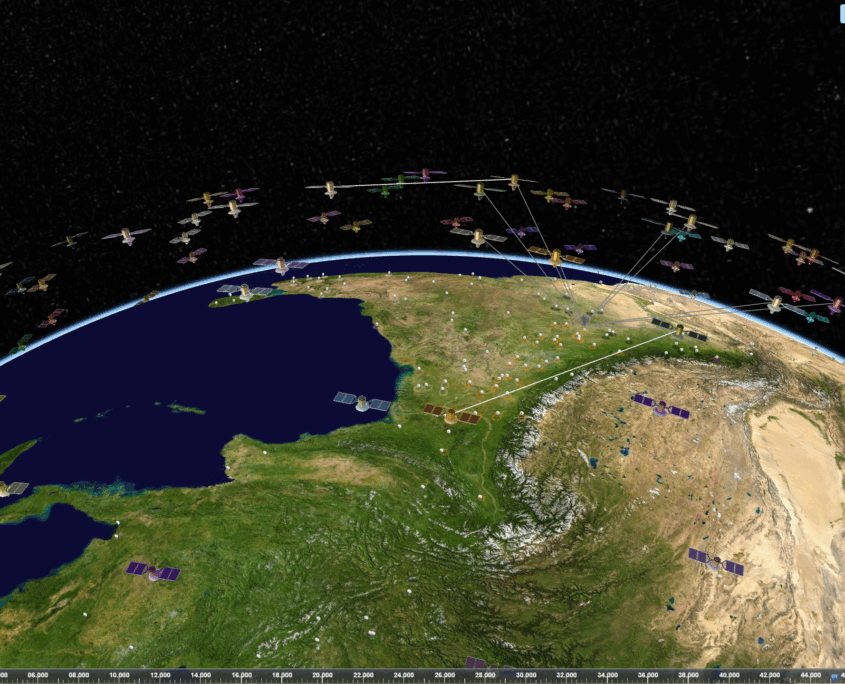
Simulation provides a controlled environment for exploring airborne communication system performance, including key aspects such as interference, coverage, traffic volume, and resilience. Analyze how variables like altitude, geography, and atmospheric conditions influence airborne connectivity. You can evaluate entire communication chains, assess service continuity under realistic conditions, and identify vulnerabilities or bottlenecks within the architecture.
Digital twins can model air-to-ground channels that support coordination with air traffic control, aircraft-to-aircraft exchanges that provide position and separation data, and satellite links that enable navigation, in-flight communication, and enhanced traffic management. By examining latency, interference, and potential coverage gaps, simulations help verify performance during both normal operations and degraded or failure scenarios.
Accurate perception plays a central role in aviation. Pilots, planes, and autonomous aerial platforms rely on an array of sensors to detect obstacles, navigate safely, track other objects, and make informed decisions.
Terrain, weather, line-of-sight, and signal quality all shape visibility and how well sensors perform. Anticipating their impact is essential for ensuring operational reliability.
System-level digital twins incorporate these parameters to create a realistic representation of airborne perception. By modeling radar, optical and infrared sensors and GNSS signals, simulations demonstrate, for example, how terrain can obscure low-altitude drones, how weather can degrade detection quality, and how signal disruption impacts information relay.
This integrated approach helps teams evaluate sensor interoperability, reduce blind spots, and enhance detection and tracking capabilities for both manned and unmanned aerial platforms. As a result, situational awareness improves and safety increases, all without introducing risk to real aircraft or crews.
Maintaining appropriate distances between aircraft is a cornerstone of global aviation safety. Regulatory authorities define horizontal, vertical, and temporal separation requirements to ensure that aircraft remain within a safe distance from each other during every phase of flight, reducing collision risk.
For example, aircraft traveling along the same route must maintain at least 15 minutes of flying time between them, while vertical separation requirements typically mandate a minimum of 300 meters between flight levels.
These regulations vary depending on the type of vehicle and mission. UAV swarms may operate closer together for coordinated maneuvers, while HAPS platforms typically operate far above conventional air traffic like planes.
Simulation provides a means of modeling these distances with precision, predicting conflicts, and confirming compliance with regulations. It also illuminates the ways in which distance influences communication performance among aircraft, satellites, and ground systems.
High-demand airspace, emergency rerouting, and complex traffic flows can all be explored within a digital twin, ensuring that safety margins are preserved even as airspace usage intensifies.
Aviation complexity becomes most evident when multiple aircraft and systems operate together within shared airspace. In these environments, the behavior of the overall system is shaped not only by individual aircraft performance but by the interactions between them.
System-level simulators allow these interactions to be explored in depth. Airplanes may adjust speed and altitude in response to weather and congestion, UAVs may coordinate with one another to complete missions while avoiding conflicts, and satellites or HAPS may dynamically allocate communication resources to support various airborne units simultaneously.
You can also analyze how multiple units collectively respond to unexpected events such as weather disruptions, communication lapses, or emergency diversions. Simulation reveals patterns, such as how traffic congestion develops, how conflicts spread, and how coordinated maneuvers unfold. This offers insights that are not apparent when examining platforms in isolation.
At the broadest level, aviation must be understood as a connected system in which airspace management, airport operations, and diverse aircraft types all influence one another. End-to-end simulation provides this holistic view, enabling planners to study how local decisions can scale into even global outcomes.
This layer of analysis encompasses strategic, system-level aspects such as overall traffic flow, airport throughput, runway sequencing, surface movements, and coordination between manned and unmanned systems.
It also provides a framework for evaluating the impact of disruptive events. A major storm, for example, can ripple through multiple airports, affecting airspace availability, routing, and schedules. Similarly, sudden drone sightings near airports – as has occurred across Europe in 2025 – can trigger temporary closures, cancellations, and widespread rerouting.
By simulating such scenarios, decision-makers can anticipate cascading effects, evaluate alternative strategies, and optimize procedures across all levels of operation.
Through this integrated perspective, system-level digital twins create a predictive, adaptive environment for managing complexity. They enable aviation stakeholders to plan proactively, respond more effectively, and maintain a high standard of safety across an increasingly dynamic airspace.
C-DReAM: System-Level Digital Twins for Smarter Connectivity & Mobility
ALIX: Protocol-Level Simulations for 5G Terrestrial & Non-Terrestrial Networks
Magister SimLab: Graphical User Interface for Versatile Simulation Campaigns

Accelerating the future of wireless system development today with system-level digital twins and detailed simulations.



Sepänkatu 14 C 16 FIN-40720 Jyväskylä, Finland
Business ID: 1998796-8
VAT number: FI19987968
info(at)magister.fi