Optimize End-To-End Broadcasting with System-Level Digital Twins
January 19, 2026

January 19, 2026
The broadcasting industry is undergoing one of the largest transformations in its history. Traditional radio and television systems now operate alongside streaming applications, smart TV, OTT (over-the-top) platforms, integrated 5G and satellite, and countless user devices from phones to smart watches and car systems.
For broadcasters and network operators, this creates both opportunity and complexity. How do these systems interact in practice? To accurately predict and optimize performance, broadcasters need a way to model how terrestrial towers, satellite payloads, 5G cells, cloud platforms, and millions of diverse end-user devices perform alongside each other.
System-level digital twins provide this needed clarity. By recreating broadcasting environments in high-fidelity digital format, they make it possible to experiment with new architectures, evaluate emerging technologies, identify risks, and optimize performance – before making changes in the real world.
Broadcasting is about delivering content to large audiences – whether through radio waves, cables, satellite signals, or internet-based platforms. As digital technologies evolve, the line between traditional broadcasting and digital delivery continues to blur: a programme may air live on television, stream on an app, and later appear in an on-demand library.
Today’s broadcasting landscape involves terrestrial towers (AM/FM, DVB-T/ATSC), satellite signals (DVB-S2X, DVB-RCS2), cable infrastructures, internet platforms, as well as telecommunication networks. As broadcasting evolves, 5G is emerging as a cornerstone technology, enabling more flexible, mobile, and responsive content distribution. Projects like 5G-EMERGE explore hybrid satellite-terrestrial broadcasting that moves content closer to users via edge delivery. AI and ML technologies are also gaining momentum, further enhancing analytics, traffic prediction, and personalization.
System-level digital twins bring all these elements together. Instead of treating broadcast elements as isolated systems, a digital twin models the entire end-to-end-chain as one interconnected ecosystem.
This includes, for example, studio playout, terrestrial towers, satellite uplinks and downlinks, content delivery network (CDN) distribution layers, and end-user devices. Engineers can detect bottlenecks, evaluate interdependencies, reproduce complex behaviors, and analyze the impact of emerging technologies long before deployment.
By analyzing different network designs and operational scenarios, simulation supports strategic planning, technology integration, and spectrum-efficient, cost-effective, and highly reliable broadcast service quality.
Peak-load events remain one of the most demanding challenges in modern broadcasting. During moments such as major sports finals, national elections, or breaking news, millions of viewers may join simultaneously – placing sudden, intense pressure on every part of the distribution chain.
Today’s audience is also more diverse than ever. A single global event may involve millions of satellite terminals, households connected through terrestrial transmitters, mobile devices on 5G networks, and viewers on smart TVs. Each device class reacts differently under congestion: mobile devices may aggressively reduce bitrate, older receivers may stall, and satellite terminals may experience tightening link margins near beam edges.
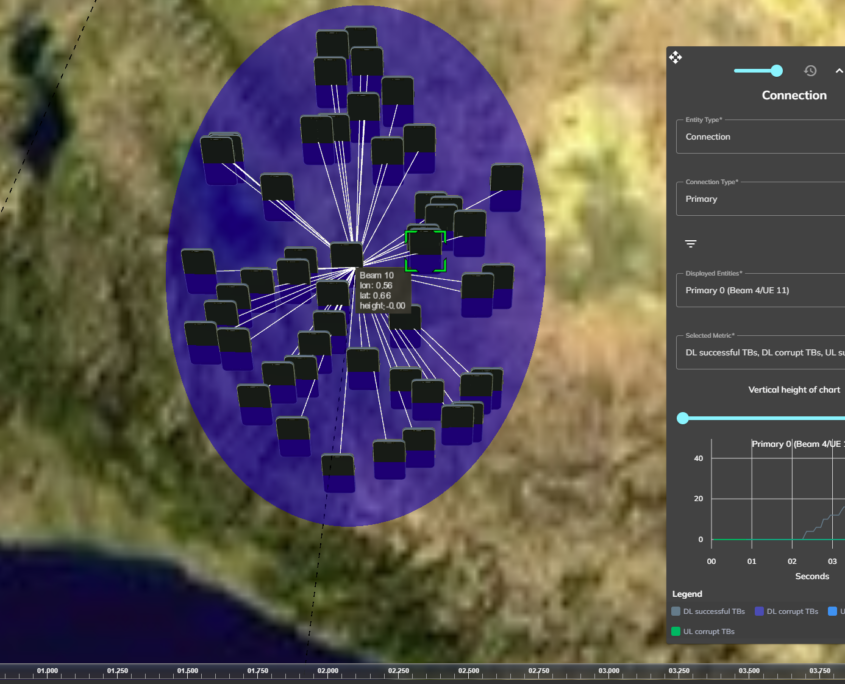
System-level simulation makes it possible to model how all these devices behave together under extreme load. Network operators can replicate millions of concurrent joins, simulate satellite link dynamics, assess ABR (adaptive bitrate streaming) player reactions, and study how network failures propagate through the delivery chain.
The digital twin can predict when latency spikes cause widespread buffering, how DVB-RCS2 return channels respond under mass interactivity, or how collective user actions – such as rewinding during halftime – affect overall stability.
This approach allows broadcasters to identify vulnerabilities and optimize delivery strategies without risking real-world outages. By stress-testing in advance, networks can be optimized to remain resilient – even during peak-demand events.
DVB and 5G NR technologies are converging to create more flexible and efficient content delivery. The DVB Project is defining solutions that support an integrated broadband-broadcast future, enabling 5G networks to complement and enhance traditional DVB infrastructures.
While this interoperability is beneficial, the coexistence of DVB and 5G NR also presents some challenges. DVB-T2 and 5G NR often operate in adjacent UHF (ultra-high-frequency) spectrum within the 700/800 MHz bands, which requires careful coexistence management. When operating in close proximity, the two systems can cause mutual interference unless proper mitigation measures are implemented.
Coverage is another challenge. DVB uses high-power wide-area towers, while 5G relies on dense, low-power cells, resulting in very different coverage patterns and gaps as users move between areas. Future devices may need to dynamically switch between different delivery methods – DVB, 5G NR, multicast, and unicast – depending on what works best at the moment. This ensures a more seamless viewing experience.
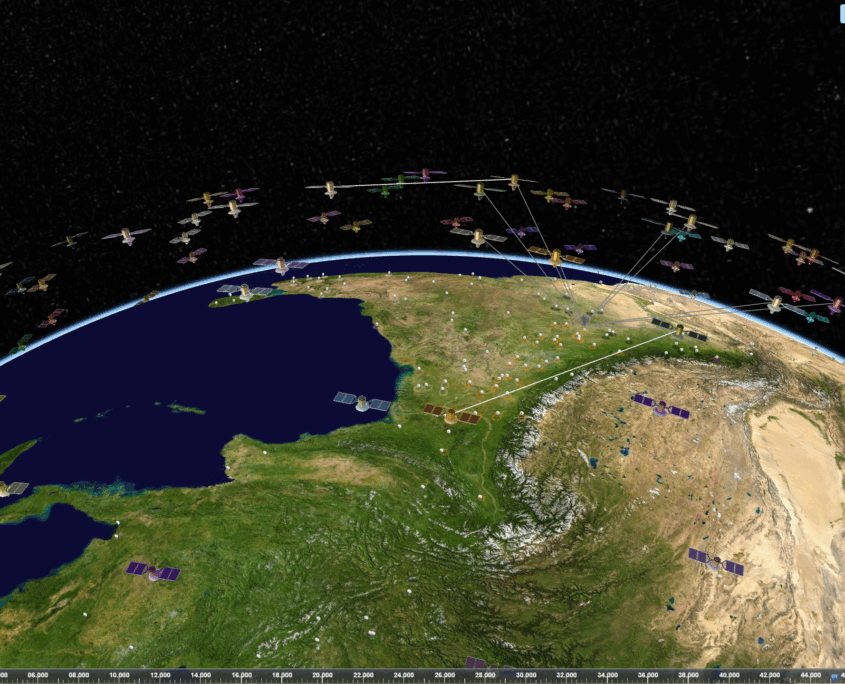
Simulation is essential for assessing these scenarios and achieving successful coexistence. Digital twins can model RF coexistence, evaluate impacts on home reception, simulate dynamic switching, and test hybrid DVB + 5G workflows. You can also compare the performance differences between DVB and 5G. For example, Magister has conducted extensive DVB/5G NR performance evaluations, including NGSO satellite scenarios.
Through full-scale virtual trials, digital twins help shape spectrum policy, guide investment decisions, and accelerate next-generation receiver development.
Broadband distribution is shifting toward architectures that move content closer to users. This can be achieved by combining the strengths of both terrestrial and satellite delivery.
Satellites provide efficient delivery of live and popular content to wide areas, but face challenges with latency and cost efficiency. Terrestrial broadcasting, on the other hand, offers low latency and high-quality transmission but struggles with geographical coverage. By integrating both, broadcasters can deliver seamless experiences – extending service to vehicles, aircraft, ships, and remote areas.
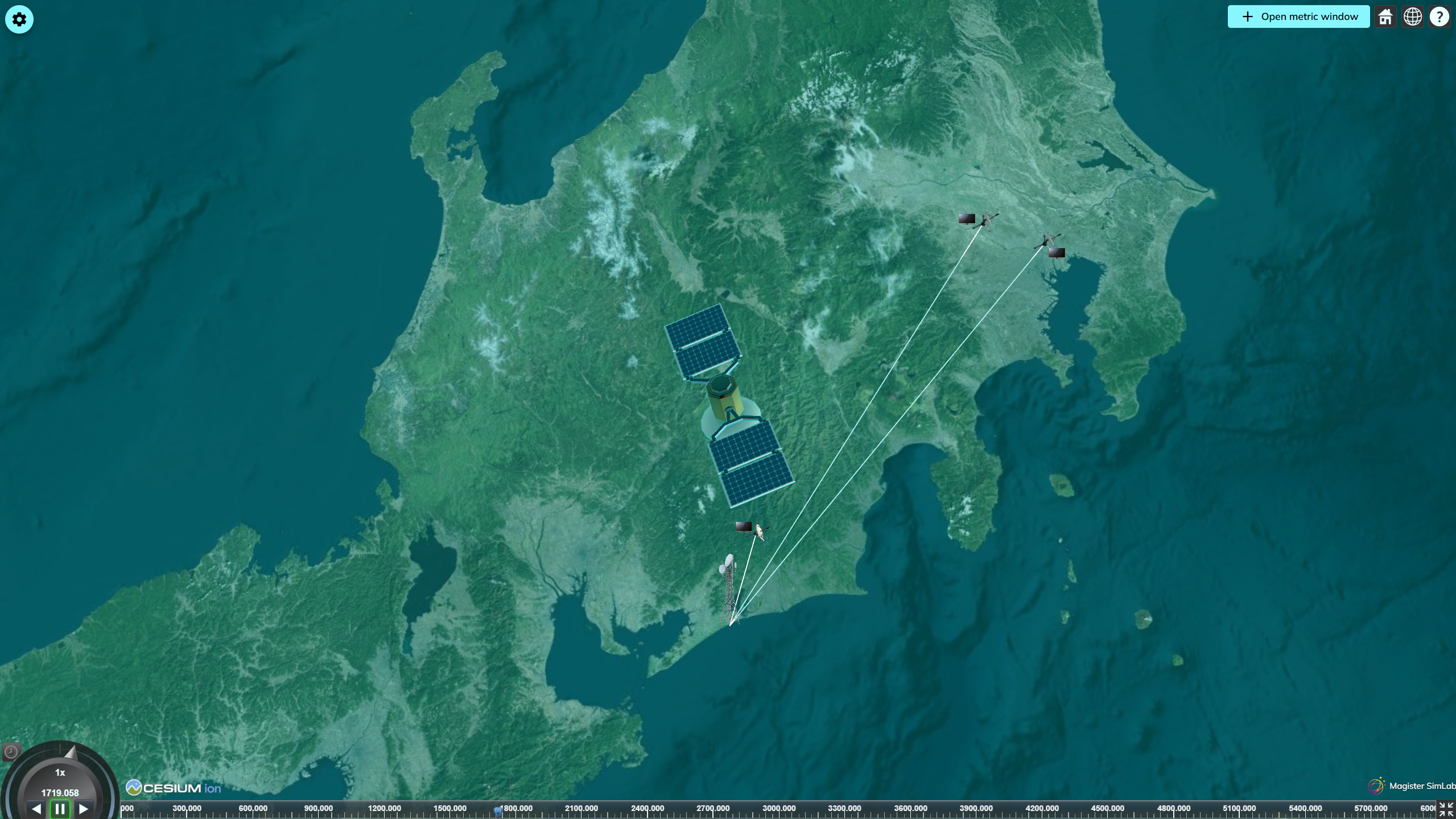
Integrating these systems requires careful management of bandwidth, spectrum, latency, adaptive streaming, and edge caching. System-level digital twins allow operators to design and validate hybrid architectures. Simulate live content delivery via satellites to the edge, analyze device transitions between satellite and terrestrial coverage, and optimize routing for synchronized, stable streams.
The 5G-EMERGE initiative is advancing satellite-assisted edge delivery and seamless satellite-terrestrial integration to enable high-quality content distribution. Magister contributes to the project through advanced simulation capabilities that model and validate these complex systems.
Ultimately, success depends on viewer experience – clarity synchronization, responsiveness, startup delay, buffering, and bitrate stability. These Quality of Experience (QoE) outcomes depend on Quality of Service (QoS) factors such as signal-to-noise ratio, packet loss, jitter, and congestion across countless devices and environments.
Device diversity adds a whole new layer of complexity. Smart TVs, set-top boxes, phones, automotive receivers, radios, and IoT devices all handle decoding and connectivity differently. Their network conditions also vary dramatically – from fiber-connected living rooms to high-speed trains and congested urban 5G cells – making QoE optimization a moving target.
System-level simulation creates a unified view of QoS and QoE. You can simulate DVB-S2X and DVB-T2 impairments, satellite fading, CDN cache policies, adaptive bitrate (ABR) player logic, device limitations, and in-home WiFi interference. This helps broadcasters tune encoding ladders, optimize latency, and ensure consistent accessibility features.
In summary, digital twins turn device and network complexity into actionable insight, ensuring more seamless viewer experiences.
Broadcast infrastructure spans antennas, towers, satellite payloads, routers, control systems, power equipment, and cloud playout platforms. As components age, environments change, and software updates roll out, operators need to anticipate failures – not just react to them.
System-level digital twins combine real telemetry with simulation to create a predictive model of network health. Because the twin understands not only the condition each component but also the interactions between them, they can detect early degradation and recommend actions like adjusting power levels, rerouting traffic, or shifting delivery paths.
Crucially, simulation environments also make it possible to rehearse fault scenarios that cannot be tested live. For example, operators can simulate CDN outages during major events, transmitter power loss, or encoder failures. Validate failover mechanisms, measure recovery times, and verify that the viewer experience remains protected under stress.
Digital twins transform operations from reactive troubleshooting to proactive resilience engineering – protecting continuity, trust, and revenue.
C-DReAM: System-Level Digital Twins for Smarter Connectivity & Mobility
ALIX: Protocol-Level Simulations for 5G Terrestrial & Non-Terrestrial Networks
Magister SimLab: Graphical User Interface for Versatile Simulation Campaigns

Accelerating the future of wireless system development today with system-level digital twins and detailed simulations.



Sepänkatu 14 C 16 FIN-40720 Jyväskylä, Finland
Business ID: 1998796-8
VAT number: FI19987968
info(at)magister.fi