6 Ways System-Level Digital Twins Are Enhancing Railway Safety and Predictability
January 12, 2026
January 12, 2026
Railways have always been about precision – keeping trains moving safely and on time across vast, interconnected networks. Growing passenger demand, aging infrastructure, sustainability targets, and the rise of digital technologies are reshaping how rail systems operate. At the same time, new risks such as cyber threats add even more layers to an already multi-faceted environment.
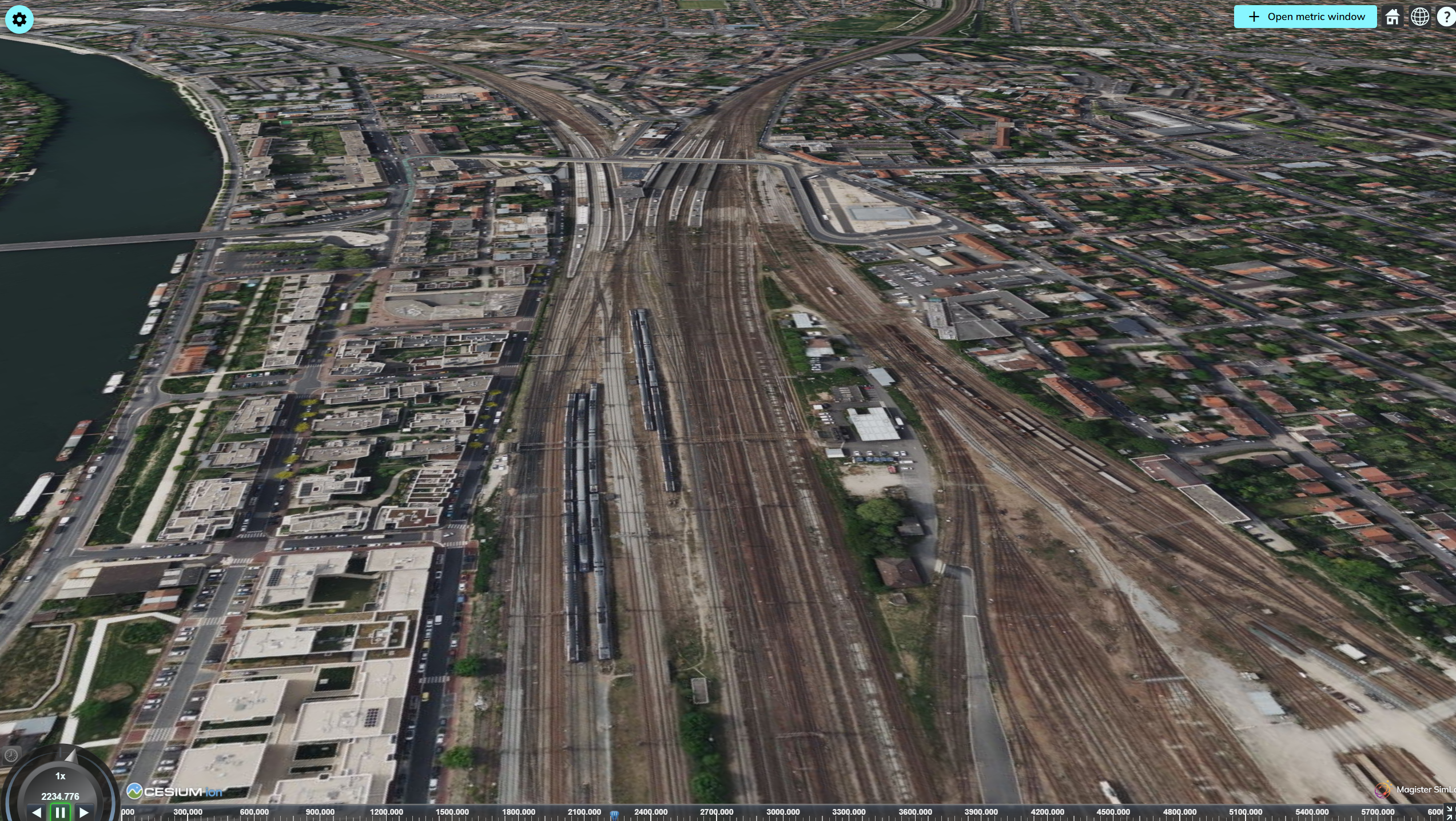
To manage the full landscape of railway operations, it’s crucial to be able to view the whole system and the interdependencies within. System-level digital twins provide a holistic, virtual representation of railway operations, integrating trains, infrastructure, communications, and station activities.
In this blog post, we’ll go over how system simulation helps optimize key areas of the railway sector: connectivity, cybersecurity, safety, energy efficiency, and predictive maintenance. Each of these aspects is critical to building a railway system that is sustainable and ready for the future.
Reliable connectivity is essential for railway operations. It enables communication between trains and control centers to maintain situational awareness, ensuring safe distances between trains, and the exchange of critical safety and security messages. Connectivity also enhances passenger experience by supporting onboard internet access for entertainment, instant messaging, and remote work – for example.
Railways today rely on different communication networks. GSM-R (Global System for Mobile Communications – Railway), the long-standing industry standard, provides secure voice and data links for railway operational staff. Driven by growing communication demands and the digital transformation, the sector is slowly transitioning towards FRMCS (Future Railway Mobile Communication System), a 5G-based system designed to deliver higher bandwidth, lower latency, and enable advanced passenger services. GSM-R will become obsolete around 2035, and FRMCS planning and piloting is already underway to enable a smooth transition.
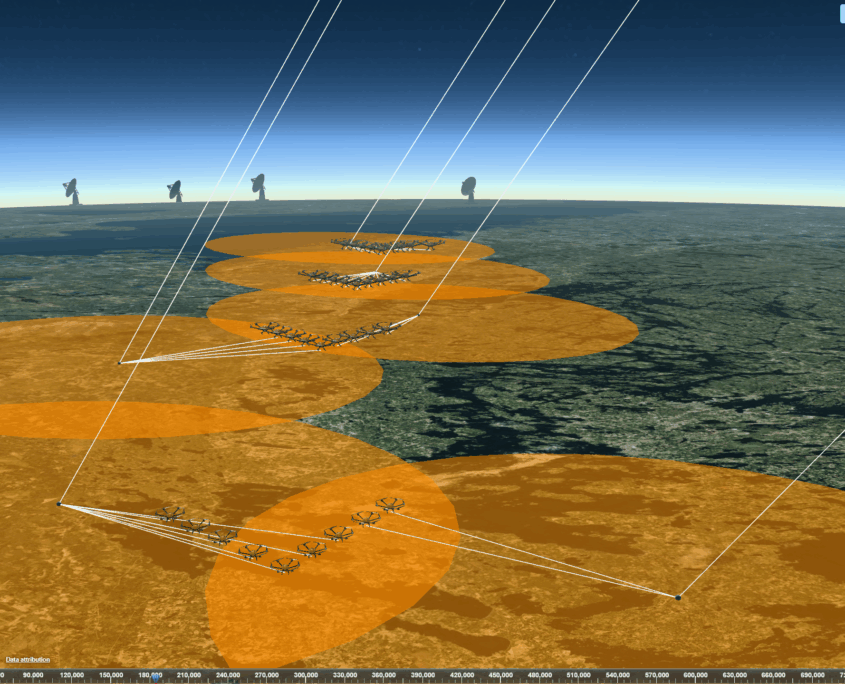
In areas with limited terrestrial coverage, operators are also exploring satellite connectivity through 5G Low Earth Orbit (LEO) constellations to fill communication gaps, improving both operational safety and passenger convenience.
A system-level digital twin can model all these communication layers together, allowing operators to test coverage, handovers, congestion, and failure scenarios safely in a virtual environment. Model the system from the physical layer – including signal propagation, interference, and fading – to link budget calculations, including real-time SINR (signal-to-interference-plus-noise-ratio) and error rates.
Evaluate railway-specific connectivity scenarios, such as signal propagation challenges in tunnels. Analyze the impact of very high speeds on service quality for applications like real-time diagnostics, signaling commands, and passenger connectivity. Plan capacity and resilience for future digital services, such as autonomous train control and remote train operation. Assess communication coverage areas, for example, identifying when handovers occur between terrestrial and satellite systems.
Simulation helps you adapt to evolving requirements without redesigning the entire network, which is crucial as digital transformation drives new data-heavy applications. For example, you can plan the migration from GSM-R to FRMCS, validate functionality, and ensure resilient communications as digitalization accelerates.
Aging infrastructure and high-utilization assets make maintenance one of the biggest challenges for rail operators. Unexpected track defects, worn switches, or rolling-stock failures can disrupt services, increase costs, and compromise safety.
Modern technologies such as the Internet of Things (IoT) and artificial intelligence (AI) are increasingly used to monitor railway equipment and infrastructure. IoT sensors can be deployed across railway systems to collect data on track conditions and equipment health. AI algorithms then analyze this data to detect patterns, identify anomalies, and predict potential failures.
By integrating this data into a system-level digital twin, operators can simulate the entire railway network under different circumstances – such as extreme weather, high-speed operations, or increased traffic loads. Predictive maintenance strategies can then be applied across assets, pinpointing which components are likely to fail and when. This enables optimized maintenance schedules that minimize service disruptions, reduce operational costs, and extend the lifespan of critical infrastructure such as tracks, signaling systems, and power supply units.
In simulation, “what-if” scenarios – such as deferred maintenance, extreme weather, or increased traffic – can be tested safely in a virtual environment. This ensures that decisions are data-driven and aligned with safety and efficiency goals.
Railways are becoming increasingly connected, which exposes them to different cyber threats. Modern signaling systems, train control platforms, IoT devices, and passenger information systems all expand the attack surface. In addition to physical safety, which has always been central to railway operations, data protection is now another priority.
Cybersecurity in rail is about more than protecting IT systems. For example, ransomware attacks and malicious intrusions can halt operations, compromise signaling, and even lead to collisions or derailments. Data breaches may expose passenger information, causing privacy violations, regulatory penalties, and reputational damage.
System-level digital twins help strengthen resilience by simulating threats and vulnerabilities without risk to real-world operations. Operators can simulate potential cyberattack scenarios, pre-plan responses to anticipated threats, and practice crisis response procedures.
For example, you can evaluate network performance under jamming conditions. Explore adaptive modulation and coding strategies based on link quality – as trains travel through variable environments and coverage areas. Simulate loss-of-service situations and analyze how the network can autonomously reconfigure to maintain continuous connectivity.
Simulation also makes it possible to evaluate the feasibility and reliability of emerging technologies. Identify potential bottlenecks and vulnerabilities in communication architectures early in the development cycle.
High-quality 3D proof-of-concept visualizations help you easily demonstrate planned technologies and deployments to relevant stakeholders, customers, and colleagues. This enables proactive threat detection, operational readiness, and safer adoption of innovation.
Rail networks are intricate systems where even a small delay can ripple across hundreds of kilometers. Operational efficiency requires ensuring trains move safely and on time despite limited track capacity, mixed passenger and freight traffic, and strict safety constraints. Every decision – from routing and scheduling to managing speed limits – affects the entire network.
A system-level digital twin provides a unified model of this ecosystem. It captures train dynamics such as acceleration, braking patterns, and distances between trains, integrating them with infrastructure data, signaling logic, and communications. This allows operators to test how adjustments to timetables, speed, or routing influence both capacity and punctuality.
In day-to-day operations, the digital twin becomes a strategic decision-support tool. When a train is delayed, a switch fails, or weather impacts visibility, operators can simulate different dispatching or rerouting strategies in seconds and choose the one that minimizes knock-on effects. Complex station operations – like platform occupancy, turnaround times, and passenger transfer flows – can be managed more effectively by testing scenarios virtually at first.
By combining real-world data with predictive simulation, system-level simulation helps you shift from reactive management to proactive optimization. This results in smoother traffic flow, fewer conflicts, and consistently higher reliability across the rail network.
Although rail transport is more sustainable than road or air travel, it still consumes significant amounts of energy. Ever acceleration, braking event, timetable choice, and speed constraint influences how much traction power a train requires.
When operations are not optimized, unnecessary stops, abrupt speed changes, and congestion lead to wasted energy and higher emissions. Smooth traffic flow reduces the need for harsh braking and rapid acceleration, while well-managed speed profiles help trains maintain momentum without compromising safety of punctuality.
System-level digital twins bring visibility into how energy is used across the entire rail network. It models train dynamics, gradients, timetables, rolling-stock characteristics, and power supply constraints, revealing where energy losses occur. This helps detect opportunities for improvement and better understand how different operational decisions influence consumption.
These insights can be used to design energy-efficient driving strategies, optimize routing, or adjust speed limits and dwell times in ways that reduce power demand while maintaining performance.
Railways are inherently high-stakes systems, making safety the cornerstone of operations. Ensuring safety requires careful optimization of train movements, proactive planning, and rigorous testing of both equipment and operational procedures.
Risk management in rail goes beyond reacting to incidents: it’s about predicting and preventing them. Variables such as braking distances, weather, track conditions, and train spacing all interact in complex ways. Understanding these interactions is essential to mitigating risk effectively.
System-level digital twins allow operators to model the railway network under a wide range of scenarios, from everyday operations and high-impact events. By simulating railway dynamics, you can identify sections at higher risk due to wear, weather, or operational stress, enabling preventive maintenance or temporary operational adjustments. This approach helps mitigate vulnerabilities before they lead to accidents.
Digital twins also support emergency preparedness by simulating worst-case scenarios, such as collisions or infrastructure failures. Operators can refine response procedures and rehearse actions without putting people or assets at risk.
The result is a railway that is not only more resilient to accidents but also better prepared to minimize risks and respond effectively when incidents occur.
C-DReAM: System-Level Digital Twins for Smarter Connectivity & Mobility
ALIX: Protocol-Level Simulations for 5G Terrestrial & Non-Terrestrial Networks
Magister SimLab: Graphical User Interface for Versatile Simulation Campaigns
Accelerating the future of wireless system development today with system-level digital twins and detailed simulations.



Sepänkatu 14 C 16 FIN-40720 Jyväskylä, Finland
Business ID: 1998796-8
VAT number: FI19987968
info(at)magister.fi