System-Level Digital Twins for Space: 6 Key Benefits
December 4, 2025
December 4, 2025

From global 5G NTN communications and Earth observation to navigation and defence, space-based systems have become critical to modern life – without many even realizing it.
The growth brings incredible opportunities for humanity, but also new levels of complexity. As more satellites, spacecraft, and space systems are launched, the orbital environment is getting crowded, and the stakes for reliability and sustainability are higher than ever. Organizations must strive to design systems that not only perform robustly but also anticipate risks, optimize resources, and adapt to evolving industry standards.
Simulation technology is helping the space industry tackle these challenges. With system-level digital twins, companies can model entire satellite constellations, enhance Space Situational Awareness, and make informed decisions before committing to expensive hardware and launching.
In this blog article, we demonstrate six critical areas where system simulation delivers value – helping the space industry move faster and design systems that stand the test of time.
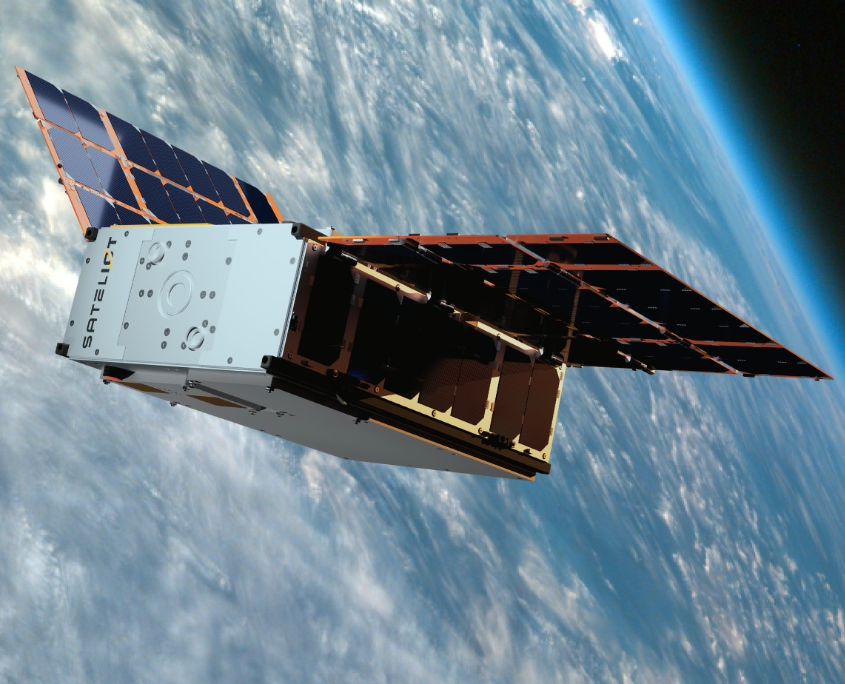
One of the most significant phenomena in the space industry today is the deployment of large Low Earth Orbit (LEO) satellite constellations for applications such as satellite telecommunications, Internet of Things (IoT) connectivity, and Earth observation. For example, satellites can extend the reach of 5G networks by providing coverage in remote and underserved areas where terrestrial infrastructure is limited.
While launch costs have decreased, deploying constellations of tens, hundreds, or thousands of satellites is still a major investment. With Low Earth Orbit becoming increasingly crowded, careful planning and optimization are essential – not only to ensure performance but also to prevent failures that could lead to costly losses or more space junk from dysfunctional satellites.
System-level digital twins allow you to design and optimize constellations for LEO, MEO (Medium Earth Orbit), or GEO (Geostationary Orbit). Whether your constellation includes tens or thousands of satellites, simulation provides a comprehensive view of performance in different conditions. This ensures that your constellation meets its intended use cases, from broadband connectivity to hyperspectral imaging.
In addition to optimizing performance, simulation helps reduce costs. Instead of relying on expensive physical testing, you can reproduce scenarios virtually and run them as many times as needed. Adjust parameters instantly, evaluate capacity under different design assumptions, and mitigate signal interference.
You might even discover opportunities to reduce the number of satellites without compromising service quality. Find the ideal balance between performance, quality, and cost in a risk-free environment.
Coverage is one of the most critical factors in constellation and space system design. Whether you’re planning communications, Earth observation, or scientific missions, understanding the satellite coverage requirements needed to meet your performance goals is essential.
Different mission types impose different coverage demands – such as revisit frequency, duration of visibility over a specific region, and the number of satellites required to achieve reliable service. For example, in synthetic aperture radar (SAR) and hyperspectral imaging, ensuring sufficiently frequent revisit times is crucial to keep data up-to-date and capture changes over time accurately.
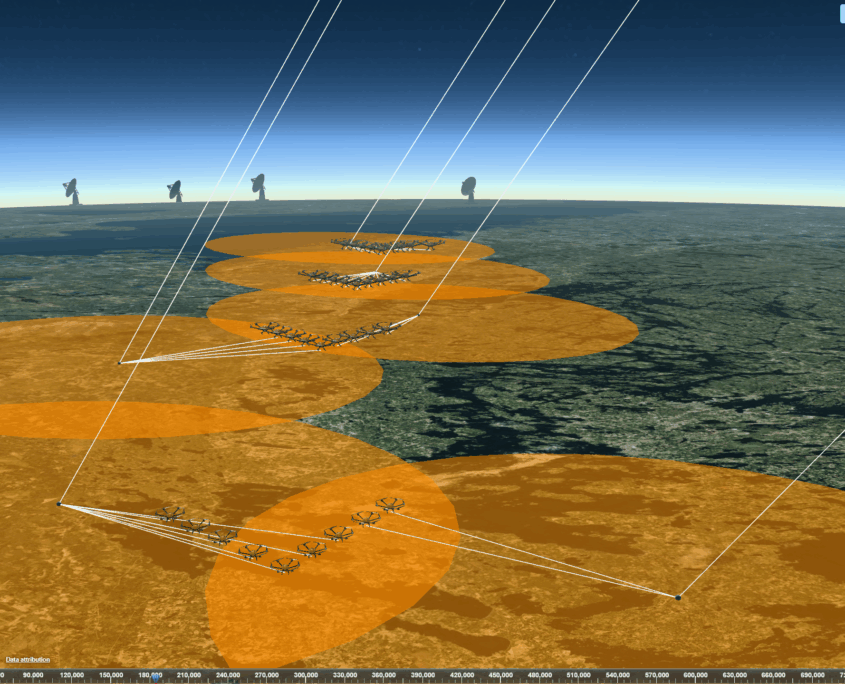
Our simulation tools help you analyze these factors with precision. You can model and visualize satellite placement, evaluate visibility for target regions, and study revisit times, sensing intervals, and data age. The platform also integrates thermal, radiation, and energy analyses, providing a comprehensive view of spacecraft performance across its orbit.
By simulating constellation coverage before committing to hardware, you can optimize satellite placement, identify potential gaps in service, and improve overall reliability. This enables faster iteration, informed trade-offs between satellite count and coverage quality, and ensures your mission delivers consistent, high-quality performance.
Space Situational Awareness (SSA) involves tracking, characterizing, and predicting the positions and behavior of objects in space. This knowledge is critical for monitoring potential hazards, assessing risks, and mitigating threats such as collisions.
SSA activities encompass monitoring satellites, spacecraft, and space debris, as well as understanding the interactions and distances between these objects.
Simulation provides a safe and controlled platform for evaluating SSA. By integrating both public and private data sources, you can model the trajectories of both existing space objects and planned assets. This helps minimize risks and maintain operational safety in an increasingly crowded space environment.
Within our simulation platform, you can analyze spatial relationships between space objects, including distances, collision probabilities, mutual visibility, and revisit patterns. This enables mission planners to design safer flight paths and optimize future satellite operations.
Space is an unforgiving environment. Therefore, satellites and other space systems must endure extreme conditions such as temperature fluctuations, radiation exposure, and eclipse periods that impact solar energy availability.
Building physical prototypes for large constellations is not only impractical due to cost, but also environmentally taxing and lacks the flexibility needed for comprehensive risk analysis. Yet, understanding how satellites interact at a system level – including Inter-Satellite Links, satellite handover, and resource allocation – is critical for mission success.
Simulation overcomes these challenges by enabling rapid, repeatable performance modeling that accelerates innovation. You can test interoperability and resilience against signal interference from other satellite systems or terrestrial networks, explore failure scenarios, and instantly adjust parameters to observe their impact on overall performance. Plan responses for these situations in advance.
This level of agility is not possible with physical testing. By leveraging simulation, you ensure your constellation operates reliably in harsh space conditions – while reducing cost, minimizing risk, and speeding up design cycles.
Satellite spectrum is a limited resource, which is becoming scarce as demand for connectivity rapidly grows. As more satellites and constellations are deployed, managing spectrum efficiently has become a critical part of ensuring reliable service.
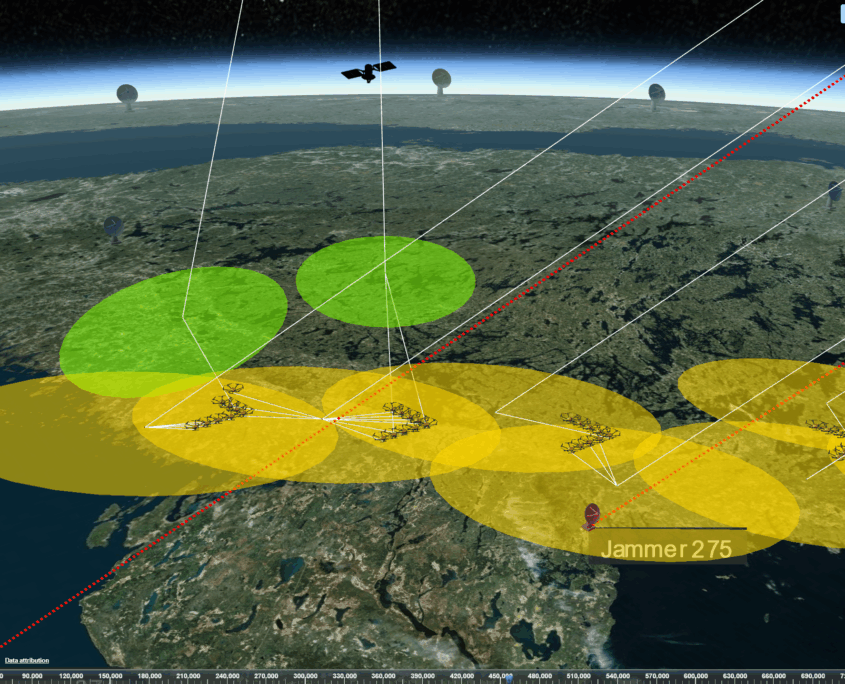
Because satellites move through different regions, they often alternate between areas with and without terrestrial network coverage. In these situations, assessing interference – whether between satellite and terrestrial networks or between multiple satellite systems – is essential to maintaining signal quality.
Simulation enables you to evaluate the extent of signal interference. By modeling various scenarios, you can determine whether interference levels are high enough to cause performance degradation, and define operational constraints to prevent service loss. This is crucial, since terrestrial network (TN) stakeholders won’t allow 5G NTNs to be deployed if they interfere with existing networks.
At Magister, we leverage these insights to support standardization efforts with organizations such as 3GPP and ETSI, helping shape specifications for 5G NTN radio performance. By integrating simulation-driven analysis into network planning, operators can ensure seamless coexistence and connectivity in an increasingly complex environment.
Designing a satellite constellation or other space system is only the beginning. Post-launch planning and continuous optimization are essential to maintain service quality and meet evolving industry and customer demands.
System-level digital twins make this possible. They allow you to optimize strategies before launch and refine them continuously after deployment. By integrating real-world performance data into the digital twin, you can fine-tune operations, anticipate capacity needs, and plan for additional satellites or gateways as demand grows.
Our simulation software keeps pace with the rapidly changing satellite industry, incorporating new standards, advanced algorithms, and bandwidth specifications to ensure compliance and future readiness. As user requirements shift, you can model new scenarios and potential services, adjust terminal and gateway configurations, and respond quickly to emerging use cases.
C-DReAM: System-Level Digital Twins for Smarter Connectivity & Mobility
ALIX: Protocol-Level Simulations for 5G Terrestrial & Non-Terrestrial Networks
Magister SimLab: Graphical User Interface for Versatile Simulation Campaigns
Accelerating the future of wireless system development today with system-level digital twins and detailed simulations.



Sepänkatu 14 C 16 FIN-40720 Jyväskylä, Finland
Business ID: 1998796-8
VAT number: FI19987968
info(at)magister.fi