State of the Art in System-Level NTN Digital Twins
October 26, 2026

October 26, 2026

Digital twins are increasingly being used to validate and optimize Non-Terrestrial Networks (NTN) and satellite communication systems.
Current NTN systems are complex, bringing together satellite constellations, terrestrial networks (TN), and diverse user segments. As these systems grow and traffic load increases due to AI processing and integrated data flow from devices to connected systems, traditional link-level and point-to-point testing and optimization approaches cannot always capture the full range of dynamic interactions across the system.
At the 5th International Symposium on Satellite Communication Systems & Services (SCSS 2026) on October 15th, Magister’s CEO Kimmo Kaario gave a keynote speech on the state of the art in system-level NTN digital twins. The presentation looked at what commercial solutions can already offer today, and the areas where further development is still needed.
This article highlights the main takeaways from the presentation, exploring the current NTN digital twin landscape, the strengths of different approaches, and how combining specialized tools can often deliver the greatest value.
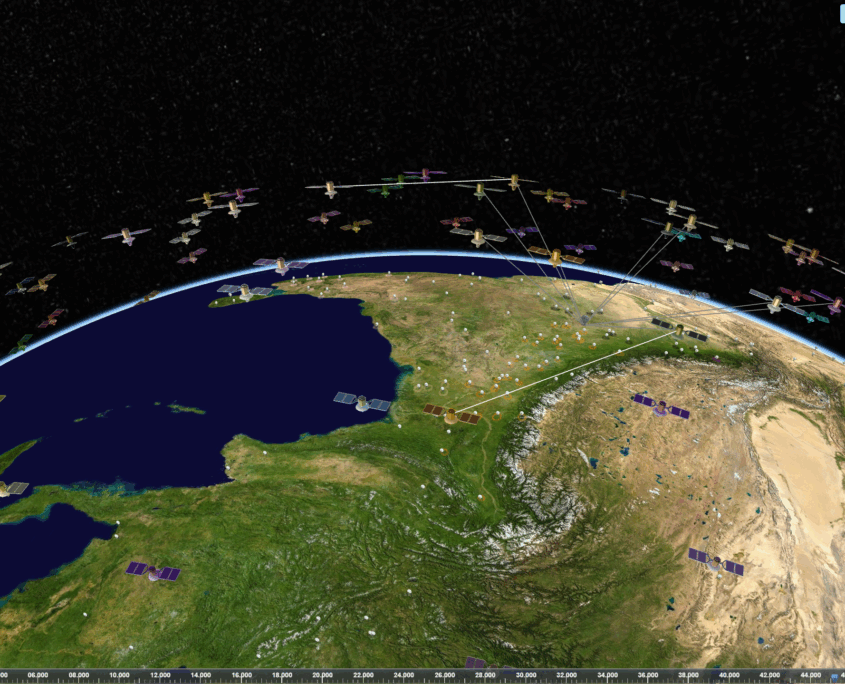
Modern NTN and satellite communication systems can involve thousands of satellites, terrestrial network components, and different user groups from IoT (Internet of Things) to mission-critical services. Network users can range from people driving cars and flying in airplanes to intelligent devices such as drones and robots. It’s increasingly important to capture the dynamic interactions between space, air, and ground segments.
Only a few years ago, SatCom systems were simpler, with constellations consisting of a relatively small number of satellites. There was also less need to integrate terrestrial systems with non-terrestrial networks.
This is now changing rapidly, as 5G/6G NTN makes it possible for the same types of devices to connect across both terrestrial and non-terrestrial networks.
In these environments, network infrastructure, channels, and service graphs continuously evolve and influence one another. To provide meaningful insights, a digital twin must accurately represent the interactions and relationships between these layers.
This includes moving topology such as satellites, beams, and feeder links, time-varying physics such as Delay, Doppler, and blockage, coupled control such as mobility, routing, and scheduling, and multi-domain service such as TN, NTN, and mixed TN/NTN.
Building a digital model of a complete NTN SatCom system is a challenging task. Compared with creating a digital twin of a car’s functionality or another factory product with a strictly defined process, modelling an entire global communications system introduces a much broader set of interconnected elements that are constantly changing.
No single product or platform can provide a full digital replica of every aspect of an NTN system. The modelling scope and level of detail need to reflect the scenario being analyzed. Therefore, we must focus on the most relevant properties when designing the system, while using appropriate assumptions for elements that have less influence on the question being studied.
Because no single solution covers every aspect of NTN design and validation, today’s commercial NTN digital twin landscape is diverse.
The ecosystem can be viewed as a stack of complementary solution families, each designed to solve a particular challenge:
Real-Time Emulation and T&M solutions are strong in validating devices, payloads, and components. They support hardware-in-the-loop and repeatable real-time lab testing, where selected links and interfaces can be represented with high fidelity.
For constellation-wide questions, however, such as traffic distribution, overall capacity, or resource allocation, additional network-level models are usually needed.
Typical solutions: RF channel emulators, UE emulators, network emulators, hardware & software testing environments
Engineering Toolboxes offer flexibility and customization. Their libraries, algorithms, open integration capabilities, and large engineering ecosystems can support a wide range of research and development activities.
The trade-off is that users must build and maintain much of the solution themselves, including the system architecture, scenarios, validation framework, user interface, deployment, and maintenance processes. This approach provides control, but it can mean investing a significant effort in developing capabilities that are already available in more specialized solutions.
Typical solutions: Scientific computing libraries, telecommunications research platforms, open-source simulation frameworks
Mission Engineering tools focus on physics-based modelling of space systems and their operating environments. Their strengths include orbit and platform modelling, coverage analysis, terrain modelling, transmitter and receiver modelling, link budget evaluation, open APIs, and integration capabilities.
For a more complete NTN network digital twin, these capabilities can be complemented by models for packet traffic and service demand, 5G NTN protocol behavior, scheduling, radio resource management, network-wide mobility and handovers, aggregate capacity, coexistence, and application-level Quality of Service.
Typical solutions: Space mission engineering, physics-based system modelling, mission analysis platforms
Arguably, the broadest NTN digital twin environments available today are Integrated Toolchains. They bring together multiple emulation, simulation, testing, and mission engineering platforms, often alongside real devices and networks, to create a more comprehensive representation of the system.
This type of collaboration is becoming more common across the industry, as companies combine capabilities from areas such as mission engineering, channel emulation, network simulation, and T&M to address different parts of the NTN system.
Typical solutions: Integrated simulation, emulation, and testing environments
Purpose-built System-Level SatCom tools focus on modelling the communication system in detail at the constellation and network level. This makes it possible to analyze interactions between satellites, networks, services, and users.
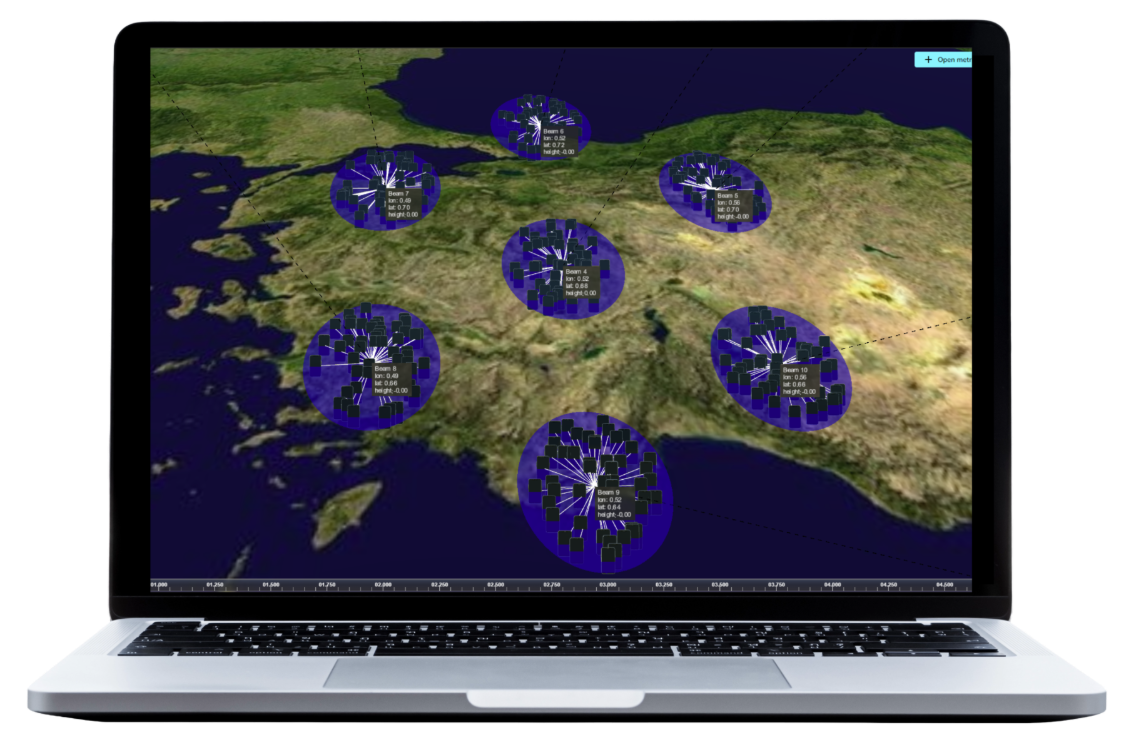
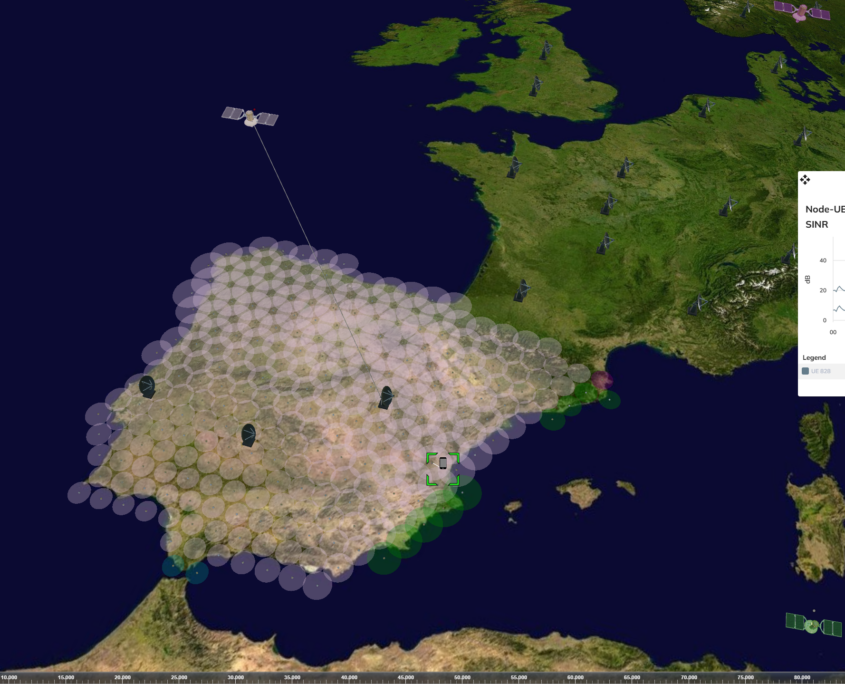
Magister’s simulation software falls into this category. C-DReAM simulates satellite constellations, coverage, capacity, resource allocation, and interference. ALIX evaluates packet- and protocol-level 5G TN/NTN behavior. SimLab provides a platform for simulation campaign management, visualization, scenario workflows, and analysis. The Satellite Trajectory Tool (STT) extends C-DReAM by providing time-stamped trajectory, channel, and connectivity state information, enabling direct integration with external NTN UE emulators.
Typical solutions: System-level constellation simulators, protocol-level 5G TN/NTN network simulators, and simulation campaign management tools
Many organizations in the cellular wireless industry use 3GPP (3rd Generation Partnership Project) channel models for evaluating wireless networks and studying traffic patterns. When utilizing these models, there are only a few alternatives to choose from. This creates potential risks if most organizations base their simulations on the same limited set of models. These models typically focus on the interaction between user equipment and satellites, while fewer models are available for feeder link modelling and measurements.
While these models are typically link-based or limited to a highly specific aspect, looking at the complete communications chain requires something more: system-level measurements and models that connect different parts of the network. One potential approach to address this is the idea of a “learning system”, where models are built case-by-case based on real-world measurements.
The concept of a learning digital twin is gaining increasing attention. In this approach, real-world RF data is used to continuously validate, calibrate, and refine the digital twin model as operational evidence accumulates.
The idea is to collect real-world RF measurements and compare them with simulated KPIs under matching conditions. Identified differences and anomalies can reveal where the digital twin needs to be adjusted. The model is calibrated by updating channel, hardware, traffic, or environmental parameters. As new data becomes available, the process can be repeated, gradually improving the accuracy and credibility of the digital twin.
AI can support this process by analyzing operational data, identifying patterns and anomalies, and extracting information that can be used to improve the digital twin. However, reliable and representative training data is essential, as poor or biased data can lead to unreliable predictions.
Across digital twin solution families, AI can support capabilities such as traffic and capacity prediction, network state estimation, resource allocation, and policy optimization. It can enhance digital twins with faster or more predictive capabilities. However, physics-based, channel, and network models keep the results grounded in real system behavior.
Combining real-world measurements, simulation, and AI could therefore make future NTN digital twins more adaptive and predictive, while preserving the credibility needed for network design and decision-making.
The current landscape suggests that a complete NTN digital twin should federate, rather than replace, the best tools available. Instead of expecting one platform to model everything, specialized tools could be connected so that each handles the part of the system it represents best.
However, making this work is not straightforward. It requires effective model governance, time alignment, open interfaces, and robust validation to allow different tools to operate together as a coherent environment.
This makes integration one of the key engineering challenges. For example: How can orbital, network, and real-time hardware models be synchronized? How can the complete end-to-end system be validated instead of evaluating individual components in isolation? And how can beams, cells, links, devices, and traffic be mapped consistently across different tools and domains?
Bringing together specialized validation tools, measurements, and AI still requires further development. But it also points towards a practical path forward: not one digital twin that tries to do everything, but a connected platform that brings together the right models and tools for the system and question at hand.

Accelerating the future of wireless system development today with system-level digital twins and detailed simulations.



Sepänkatu 14 C 16 FIN-40720 Jyväskylä, Finland
Business ID: 1998796-8
VAT number: FI19987968
info(at)magister.fi