Evaluating DVB-S2X, DVB-RCS2 & 5G NR in
Medium Earth Orbit
June 15, 2026

June 15, 2026
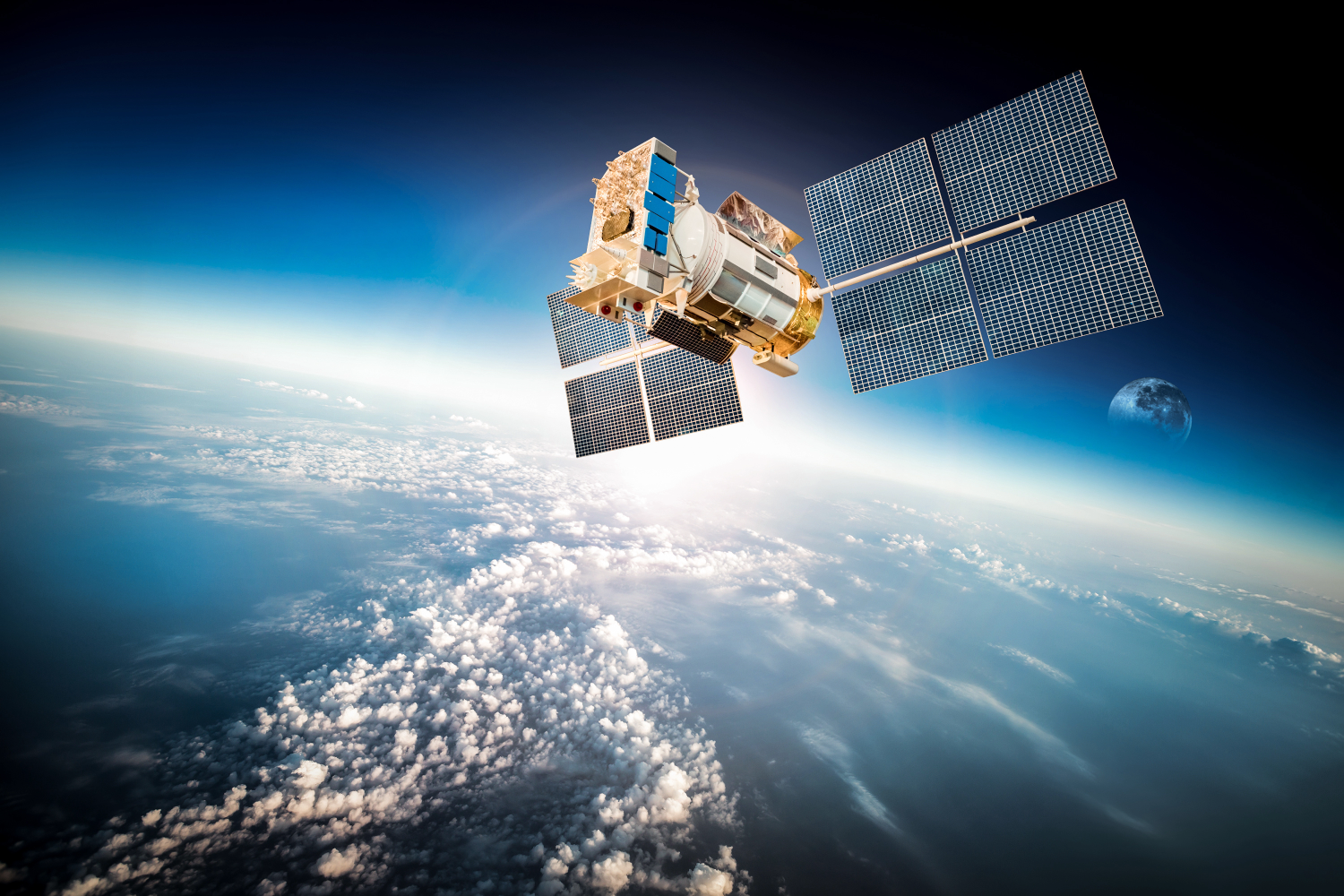
Continuing our cooperation with the DVB Project, we extended our simulation-based evaluation of DVB-S2X, DVB-RCS2, and 5G NR from Low Earth Orbit to Medium Earth Orbit constellation scenarios.
Moving from LEO at 600 km to MEO at 8,000 km altitude brings a different set of technical considerations. In LEO, Doppler shift is a dominant challenge – and the focus of our earlier analysis. At MEO altitudes, Doppler effects are less severe. Therefore, this time we focused on spectral efficiency and realistic channel conditions.
Together, the two evaluations build a more complete picture of how these communication technologies perform across different orbits.
The Non-Geosynchronous Satellite Orbit (NGSO) encompasses both Low Earth Orbit (LEO) and Medium Earth Orbit (MEO). LEO satellites orbit at around 160-2,000 kilometers above Earth, while MEO satellites operate between 2,000 and 35,786 km.
The difference in altitude impacts network performance. Higher orbits mean greater latency and slower orbital speeds. Since LEO satellites move faster, they experience larger Doppler shifts than ones in MEO. Moreover, the Doppler shift changes more rapidly in LEO compared to MEO due to the higher relative orbital speed. This Doppler shift change over time is also referred to as Doppler Rate, measured in Hz/s.
This is why our previous analysis placed greater emphasis on the effects of residual Doppler shift after Doppler compensation by the user device. In MEO, that effect is less pronounced, so the focus shifts to spectral efficiency and performance across various real-world channel conditions and traffic models.
Our evaluation compared DVB-S2X (Second Generation Satellite Extensions) and DVB-RCS2 (Return Channel Satellite Second Generation) against the 5G New Radio (NR) physical layer in Ka-band, which is often used by NGSO constellations targeting Very Small Aperture Terminal (VSAT) users. This comparison builds on our earlier LEO-600 analysis, extending it to MEO-8,000 km scenarios.
The MEO evaluation covered both link directions and two traffic models. To reflect dynamic operating conditions, we also considered channel impairments, rain, and tropospheric effects.
Through system-level simulation, we estimated the statistics of key performance metrics – system throughput, user throughput, and other indicators relevant to operators and end users – across different air interface protocols for the given scenario.
We found that DVB-S2X consistently delivered stronger downlink performance in spectral efficiency and throughput.
In uplink scenarios with rainy/cloudy conditions, DVB-S2X Normal frames delivered the best performance, while 5G NR DFT-s-OFDM (Discrete Fourier Transform-Spread-Orthogonal Frequency Division Multiplexing) generally outperformed DVB-RCS2 under the presented channel conditions. However, in clear sky simulations, DVB-RCS2 had the edge over NR, while DVB-S2X continued to deliver the best performance.
For downlink file transfer traffic (FTP3), DVB-S2X offered notably lower delay for large files, while both technologies performed similarly for small files. On the uplink side, 5G NR delivered lower delay across both traffic configurations.
Based on the simulations, DVB seems better suited for fixed, high-traffic-load connections, maintaining robust performance even under NGSO impairments. It also seemed to be a good fit for typical fixed VSAT use cases. 5G NR, while less competitive under high congestion, showed advantages in delay-critical and low-traffic-load scenarios.
As NGSO constellation deployments continue to scale globally, the SatCom industry needs clear answers to guide technology choices. Simulation-based evaluation helps ensure that these decisions are grounded in evidence.
> Learn more from the full white paper with detailed simulation results
Magister Solutions is a Finnish company that specializes in communication network simulation tools and services for modelling real-world communication systems (satellite and terrestrial) in detail.
As an independent company, we provide the industry with unbiased simulation-based evaluations of network and communication technology performance. This supports standardization and helps organizations make informed decisions about technology investments.

Accelerating the future of wireless system development today with system-level digital twins and detailed simulations.



Sepänkatu 14 C 16 FIN-40720 Jyväskylä, Finland
Business ID: 1998796-8
VAT number: FI19987968
info(at)magister.fi